

Follow us on
GrowthFactor Alternatives: Gini vs GrowthFactor
GrowthFactor alternatives come down to one question: where is the next store? GrowthFactor.ai is good retail site selection software for multi-unit retail brands, and if your whole map is the United States, stay with it. The search for GrowthFactor.ai alternatives usually starts when a European address lands on the shortlist. That is what Gini by MyTraffic was built for.
Who should stay with GrowthFactor
Data tells you what happened. Gini tells you what to do next. That is the difference between a foot traffic platform and a location intelligence companion.
There are two main cases where GrowthFactor is a better tool than Gini:
- If your expansion is entirely inside the United States, GrowthFactor's demographic layer runs on US Census and Esri data, and its vehicle counts are calibrated against 6,600 US Department of Transportation counter stations. That is deep coverage of one country. When you only need one country, their data is quite deep.
- If you want site scoring and the deal pipeline in one place: GrowthFactor carries a location from broker submission through to committee approval inside the same platform. Gini by MyTraffic does not manage deal flow. If your bottleneck is the approval process rather than the analysis behind it, that gap matters more than data coverage does.
What is GrowthFactor?
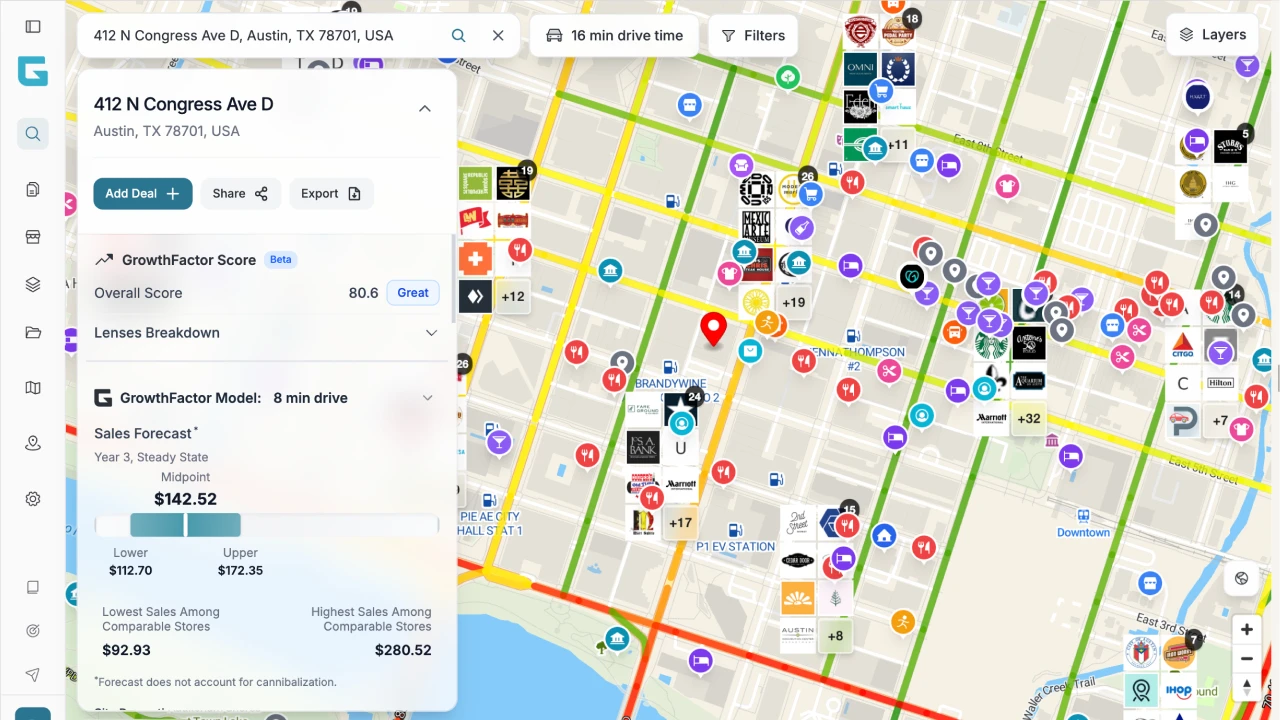
GrowthFactor.ai is a retail site selection software platform based in Boston. Founded by three MIT Sloan classmates in 2023, the company raised a $5.2 million seed round in March 2026 led by Teamworthy Ventures, and reports more than 30 customers.
Their key product does four things. It applies site scoring to a location on a 0 to 100 scale across five weighted lenses. It handles revenue forecasting as a range, where a brand has enough store history to support one. It runs cannibalisation analysis against your existing network. And it moves the deal through a pipeline from broker email to committee sign-off.
Customers are multi-unit retail and restaurant brands: Books-A-Million, Cavender's Western Wear, TNT Fireworks, 16 Handles. In August 2026 the company rebuilt the product around a conversational agent and now describes itself as the AI analyst for commercial real estate.
Why teams look for GrowthFactor alternatives
First things first, their coverage is limited to the USA. Two of GrowthFactor's four published data pillars are structurally American. Demographic data comes from US Census ACS files enriched by Esri at block-group level. Vehicle traffic comes from StreetLight, with full coverage of US Traffic Analysis Zones. Neither has a European equivalent inside the product, and GrowthFactor publishes no coverage outside the United States.
Secondly, their foot traffic data is licensed, not measured. GrowthFactor buys its footfall signal from Unacast and resells it inside the scoring model. That's fine, but it also means the depth of any trade area analysis is capped by what a third party chose to collect in that market.
GrowthFactor ends at the lease signature. GrowthFactor is built to pick a site and get it approved. Once the store is trading, the platform has little to say about store network performance, local market share, or which of your existing sites is quietly losing its catchment area.
There are very few customer testimonials or review online to check. GrowthFactor launched publicly in March 2026 and has no listing on G2, Capterra or Trustpilot. Every customer quote in circulation sits on the company's own site. For a product this new, it can make the decision of adopting the tool harder.
GrowthFactor's closest alternative for Europe: what changes outside the US
US location intelligence platforms do not fail in Europe because the software is weak. They fail because the plumbing underneath is national.
Census block groups do not exist here. Esri's two thousand US demographic variables have no counterpart that maps cleanly onto INSEE in France, ONS in the United Kingdom, Destatis in Germany or INE in Spain. Each of those bodies publishes on a different geography, at a different cadence, with different definitions of a household. Stitching them into one comparable layer is years of work, and it is the work MyTraffic has been doing since 2016.
Vehicles per day matters less too. A US site score weighs parking adequacy, ingress and egress, and traffic on adjacent roads, because most American retail is drive-to. A high street in Lyon or a station retail unit in Milan is walked to and ridden to. Score it on car counts and you will rank it last.
Gini by MyTraffic covers up to 18 countries across Europe and the US from a single account, on one measurement standard. That consistency is what makes a cross-border shortlist comparable, and it is the whole reason teams start looking for alternatives to GrowthFactor in the first place.
Gini by MyTraffic vs GrowthFactor
Both platforms score sites, forecast revenue and model cannibalisation. Both answer questions in plain language. The differences sit in three places: where the data comes from, how far the workflow runs after the lease is signed, and how many countries fit inside one account. The comparison table sets them side by side across data and coverage, decisions and AI, and access and fit.
Where each platform wins
Opening a store in Dallas, Denver or Des Moines
GrowthFactor. Its data stack was assembled for exactly this from day 1. Add the zoning layer and the analog-store calibration against your own portfolio, and a US real estate director gets a committee-ready first draft in under a minute. Gini covers the US well, but GrowthFactor has more historical data to work with.
Opening a store in Lisbon, Milan or Manchester
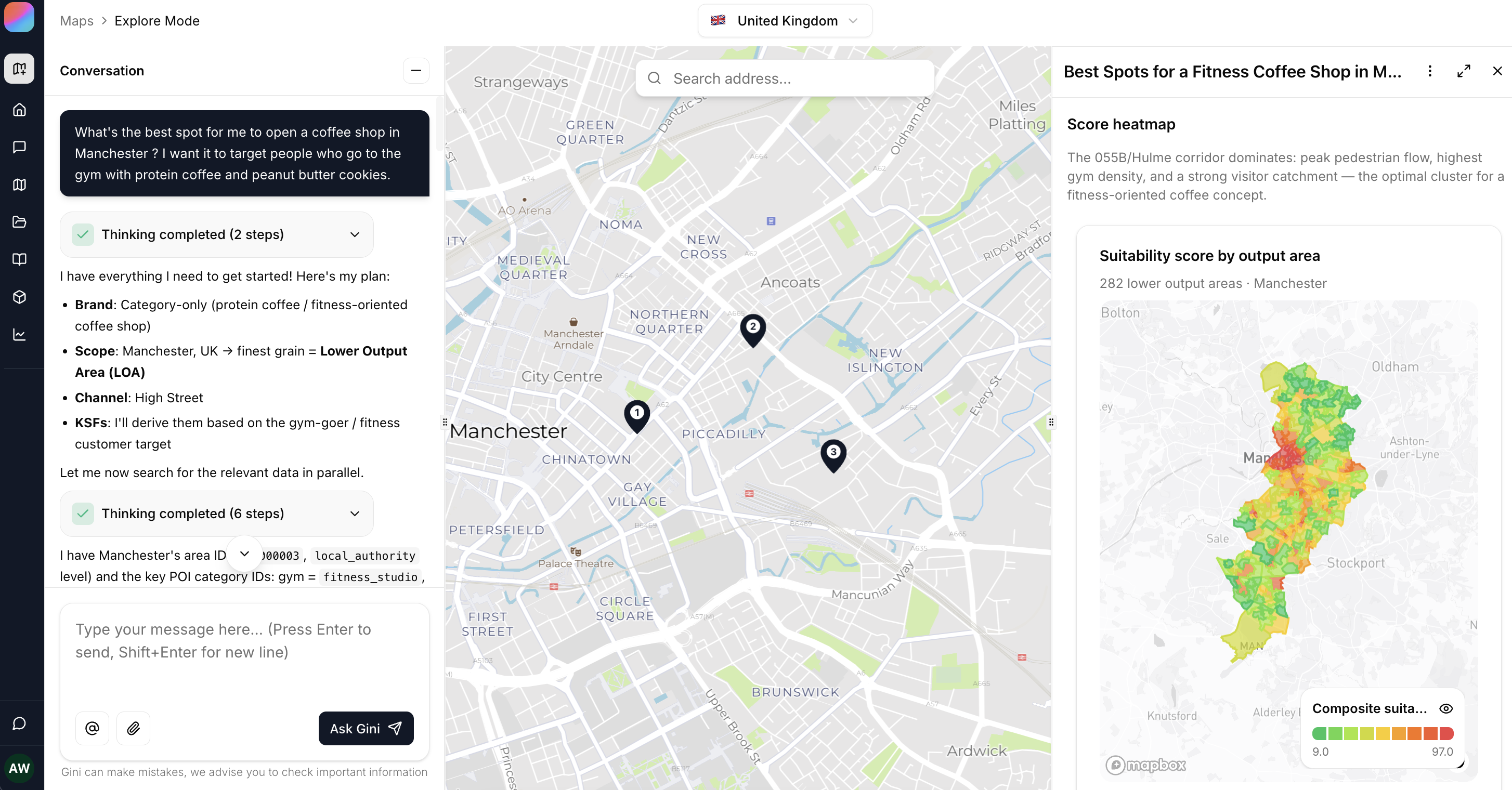
Gini by MyTraffic. Measured GPS footfall at street level, European demographic data reconciled across national statistical offices, and catchment area modelling built around walking and transit rather than parking. Ask which of four units on Corso Buenos Aires sees the most qualified traffic on a Saturday and you get an answer with the reasoning attached. GrowthFactor has no data there.
Running a network that already exists
Gini by MyTraffic. Expansion planning is one job and site scoring is one moment inside it. The harder question arrives eighteen months later, when a store underperforms and nobody can say whether the site was wrong, the catchment shifted, or a competitor opened four streets away. Gini tracks store network performance against the surrounding market continuously, and runs whitespace analysis across the territory you have not entered yet. GrowthFactor is a site selection and deal platform and does not claim this ground.
Getting a deal through the approval committee
GrowthFactor. Deal management is a first-class product for them, not an export. Broker details, LOIs and every saved analysis live against the site record, through stages your team defines. Gini produces the analysis and the shareable deliverable, exportable as a PDF. It does not replace your pipeline tracker, and it does not pretend to.
How to choose between GrowthFactor and Gini
If every site on your shortlist for the next three years has a US postcode, GrowthFactor is the more specialised product and the shorter path. Buy it, connect your store performance file, and use the five lenses to standardise how your team argues about locations. The published $200 per user per month makes that an easy test.
If any part of your growth is European, the question changes from which tool is better to which tool has data where you are going. GrowthFactor site selection scores are only as good as the layers underneath them, and those layers are American. No amount of AI on top fixes a missing measurement.
If you are running both, just use Gini by MyTraffic. You'll have precise enough data for all the decisions that matter.
Start on the Tiny plan at €249 per month with one country, or look at how the same workflows run for retail brands and franchise networks.
Frequently asked questions
What is the best GrowthFactor alternative?
It depends on the map. For US-only expansion, Gini by MyTraffic, Placer and SiteZeus are the closest substitutes. For European or cross-border growth, Gini by MyTraffic is the direct alternative, with measured footfall and demographic data across up to 18 countries in one account.
How much does GrowthFactor cost?
GrowthFactor Pro is $200 per user per month, month to month, bought self-serve with no sales call. Enterprise is quoted annually with unlimited seats and usage.
Is GrowthFactor available in Europe?
Not as a published market. The company is Boston-based, its customers are US multi-unit brands, and its store closure tracker follows US retail only. European teams evaluating GrowthFactor should ask directly which countries return a full five-lens score before committing.
GrowthFactor vs Placer.ai: which is better for site selection?
GrowthFactor, for most US site selection work. It scores sites, forecasts revenue and manages the deal in one place, where Placer.ai measures visits and leaves the decision to you. Placer.ai has the deeper US foot traffic archive. Neither covers Europe with real depth, which is the comparison we run separately against Placer.ai.
What data does GrowthFactor use?
Four licensed sources. Unacast supplies foot traffic, refreshed weekly. Esri and the US Census supply demographic data, refreshed quarterly. StreetLight supplies vehicle counts, refreshed monthly. Dataplor supplies POI data and co-tenancy, refreshed weekly. A proprietary layer adds closure signals and lease-up tracking.
Is there a free GrowthFactor alternative?
Gini by MyTraffic offers a free trial for SMB and entrepreneurs, then starts at €249 per month. There is no permanently free tool in this category with measured mobility data behind it. Free mapping tools give you a catchment area drawing, not a score you can defend.
Who is GrowthFactor built for?
US multi-unit retail and restaurant brands opening roughly three or more locations a year, with a real estate team of two to ten people and no GIS department. Books-A-Million, Cavender's Western Wear and TNT Fireworks are the reference accounts. Brands expanding across borders sit outside that profile.
See how Gini compares to other location intelligence platforms, including our breakdown of European site selection tools.
600 companies trust us





Gini by MyTraffic
Gini by Mytraffic is a European AI-powered location intelligence tool built for business decision-makers. It uses GPS mobility data to analyze foot traffic, trade areas, visitor profiles, and market potential across multiple European markets. Rather than delivering dashboards to interpret, Gini answers questions in natural language and guides users through complex workflows.

GrowthFactor
GrowthFactor is a Boston-based retail site selection platform founded in 2023 by three MIT Sloan classmates. It scores candidate locations from 0 to 100 across five configurable lenses, forecasts revenue, models cannibalisation against an existing network, and manages the deal pipeline from broker submission through to committee approval.
Empower your decisisions with location intelligence
Get started now
Q&As
How do conversations work?
Conversations are used to run workflows and analyses in Gini. Each plan includes a monthly conversation allowance, with the exception of the "Plus" plan with unlimited credits. Unused conversations do not roll over to the next billing period.
Can I upgrade or downgrade my plan?
You can change your plan at any time. Upgrades take effect immediately, while downgrades apply at the next billing cycle.
What geographies are covered?
Covered geographies include coverage across Western Europe, Eastern Europe, Scandinavia, Portugal, and the DACH region.
How does AI simplify the user experience in Gini?
Gini is designed as an interface that speaks the language of the business. AI helps structure complex questions, guide analysis, and surface insights—making advanced territorial intelligence accessible without sacrificing depth.
How do Gini workflows handle complex questions so quickly?
Gini workflows structure complex analyses into guided, end-to-end processes. By embedding best practices, data, and AI, they turn what used to take weeks into decision-ready outputs delivered in minutes.Direct integrations with major language models on the market also provides flexibility and performance.
What kind of outputs does Gini produce?
Gini goes beyond dashboards. Through its Artifact Factory, it produces concrete, shareable outputs: executive summaries, analyses, and deliverables designed to support real decisions.
Can we use our own data in Gini?
Yes. Gini allows you to bring your own data directly into the platform—either through direct inputs or API connections—combining internal data with Place DNA to unlock deeper, decision-ready intelligence.
Is Gini dependent on a single AI model or provider?
No. Gini is model-agnostic by design. It orchestrates multiple AI models and providers to ensure each task uses the most appropriate intelligence—without lock-in.
Why could some requests be really slow?
Our infrastructure is optimized for high-performance spatial queries. You get deep-dive reports in seconds that used to take consultants weeks. Key point: Before, it was a consulting service that took on average 10 days, now it takes 7 minutes.
Is all data uploaded or added to gini freemiun fully confidential and securely handled?
Yes, all data uploaded or entered into GINI (including the freemium version) is treated as confidential and handled securely.
MyTraffic applies strict technical and organizational measures to protect data, including secure hosting infrastructure, restricted access controls, and encryption.
Any content provided by users (such as prompts or uploaded documents) remains the property of the user and is processed solely for the purpose of delivering the service.You can find more details about our data protection and confidentiality commitments in our GINI Terms of Service. We can also provide, upon request, additional documentation regarding our data governance, security, and privacy framework