

Follow us on
Kalibrate alternatives: how Gini by MyTraffic compares
Kalibrate alternatives usually come down to one question: do you need a bespoke forecasting engagement, or a companion you can question today? Kalibrate is strong for fuel, convenience and US portfolio workflows. Gini by MyTraffic can do all of this across 18 markets and answers in plain language, from €249 a month.
Who should stay with Kalibrate
Data tells you what happened. Gini tells you what to do next. That is the difference between a foot traffic platform and a location intelligence companion.
Kalibrate is the right answer for a lot of buyers, and if you arrived here from a search for "Kalibrate alternatives", it is worth knowing where it wins before you look anywhere else. Two cases are clear.
If you run a fuel or convenience network, Kalibrate has been modelling fuel volumes since 1970, and it sells fuel pricing, network planning and EV charger pricing as products. Nothing else competes with that heritage, and Gini by MyTraffic does not try to.
In a similar fashion, if your estate is in the United States and your bottleneck is deal workflow, then Kalibrate Location Intelligence lets brokers submit sites into the platform, plans site tours, builds real estate committee packages, and runs on a native iOS and Android app so a field team can capture signage and competitor notes on site. That is great for expansion teams.
If either of these are important to you, then you should talk to their sales people. However, if they don't, you should keep reading this article.
What is Kalibrate?
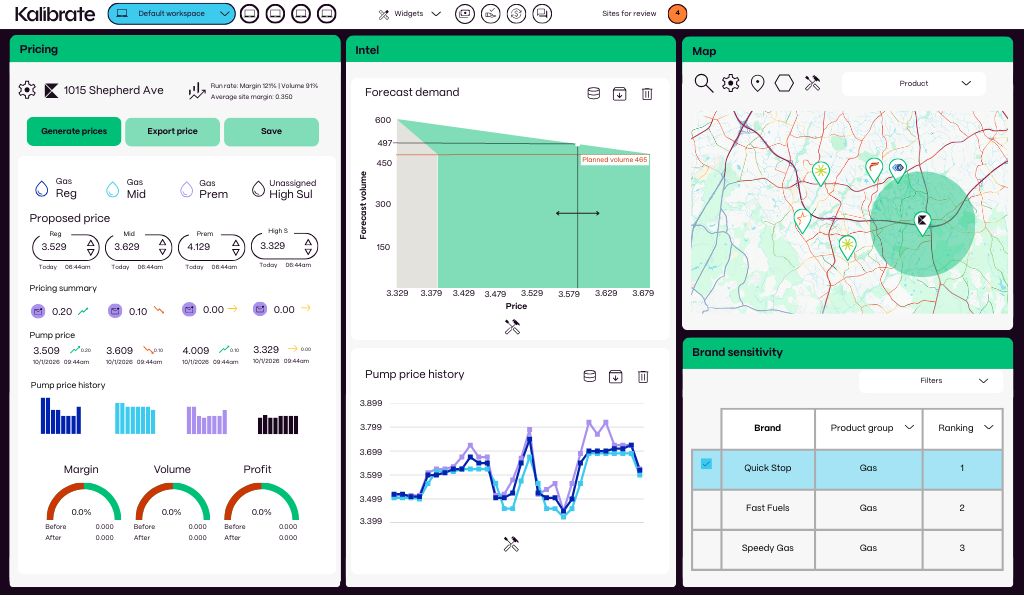
Kalibrate is a location intelligence and site selection software company. Its roots are in fuel and convenience retail: Market Planning Solutions and Knowledge Support Systems combined in 2011, and the group renamed itself Kalibrate in 2013. Private equity firm Hanover Investors then took it off the public market in 2017 in a deal valuing the shares at about £29m.
The retail platform arrived through acquisitions: Kalibrate bought Trade Area Systems and eSite Analytics in 2020, followed by Intalytics in 2021, then launched Kalibrate Location Intelligence in 2022 to bring the three under one roof. Today it sells to retail, restaurant, grocery, healthcare, financial services and franchise brands alongside its fuel business, which operates in more than 70 countries.
Why teams look for a Kalibrate alternative
The footfall layer is licensed, and it stops at the US border
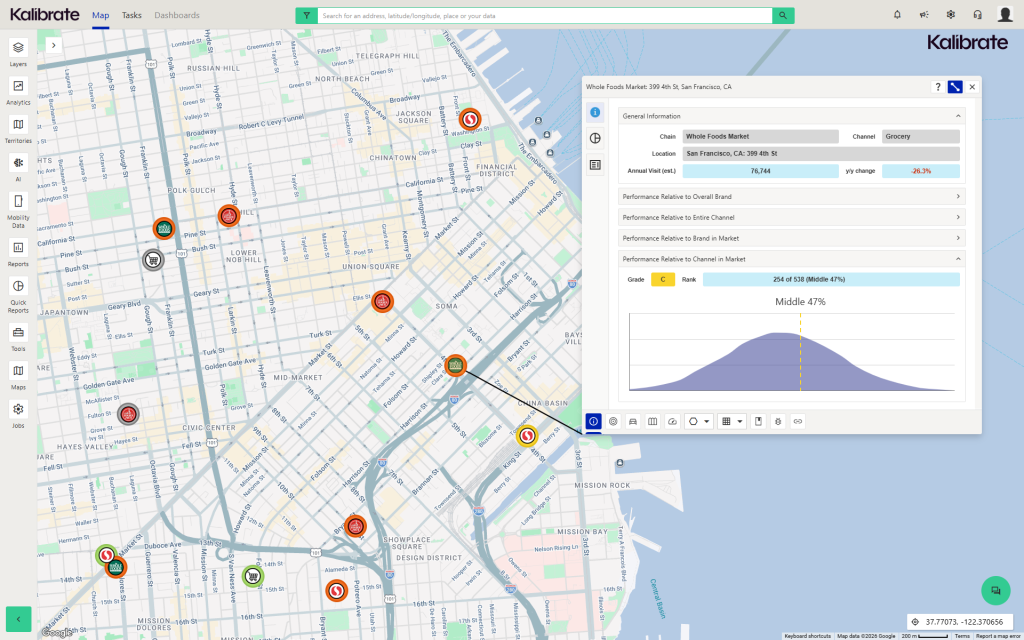
Competitive Insights is Kalibrate's foot traffic data product, and the mobility data comes from their partner Azira. This means that the answer to "where did this data come from" sits one vendor away. Kalibrate can describe the feed, but it cannot own the provenance, and the licence is separate from the platform, so the cost of that answer is separate too.
Nothing about the purchase is transparent
Kalibrate publishes no rates, and G2 records no pricing for the product. Kalibrate's own FAQ explains the variables: how much third-party data you licence, how many seats you need, and whether analytics are included. You can't simply test the product and decide whether it's worth investing in or not. The more data layers you add, the more of your budget goes into your subscription.
Every in-depth analysis comes at a cost
Predictive modeling, whitespace analysis and site evaluation sit under analytics services rather than inside the software, and Kalibrate prices its fuel site analysis by the number of scenarios modeled. This pricing model can be extremely limiting for users who simply want a clear, data-first answer.
It is built for analysts, not for you
Read the Q1 2026 release notes and the audience is explicit: the rebuilt Ad Hoc layer tool is described as commonly used by GIS analysts, operations teams and site selection teams. Kalibrate has added AI on top of it's tool, including a conversational assistant called K.ai and a forecast explainer. This is nice, but all it does is guide you through the platform's workflows, while Gini simply give you the answer in plain words.
The best alternative to Kalibrate
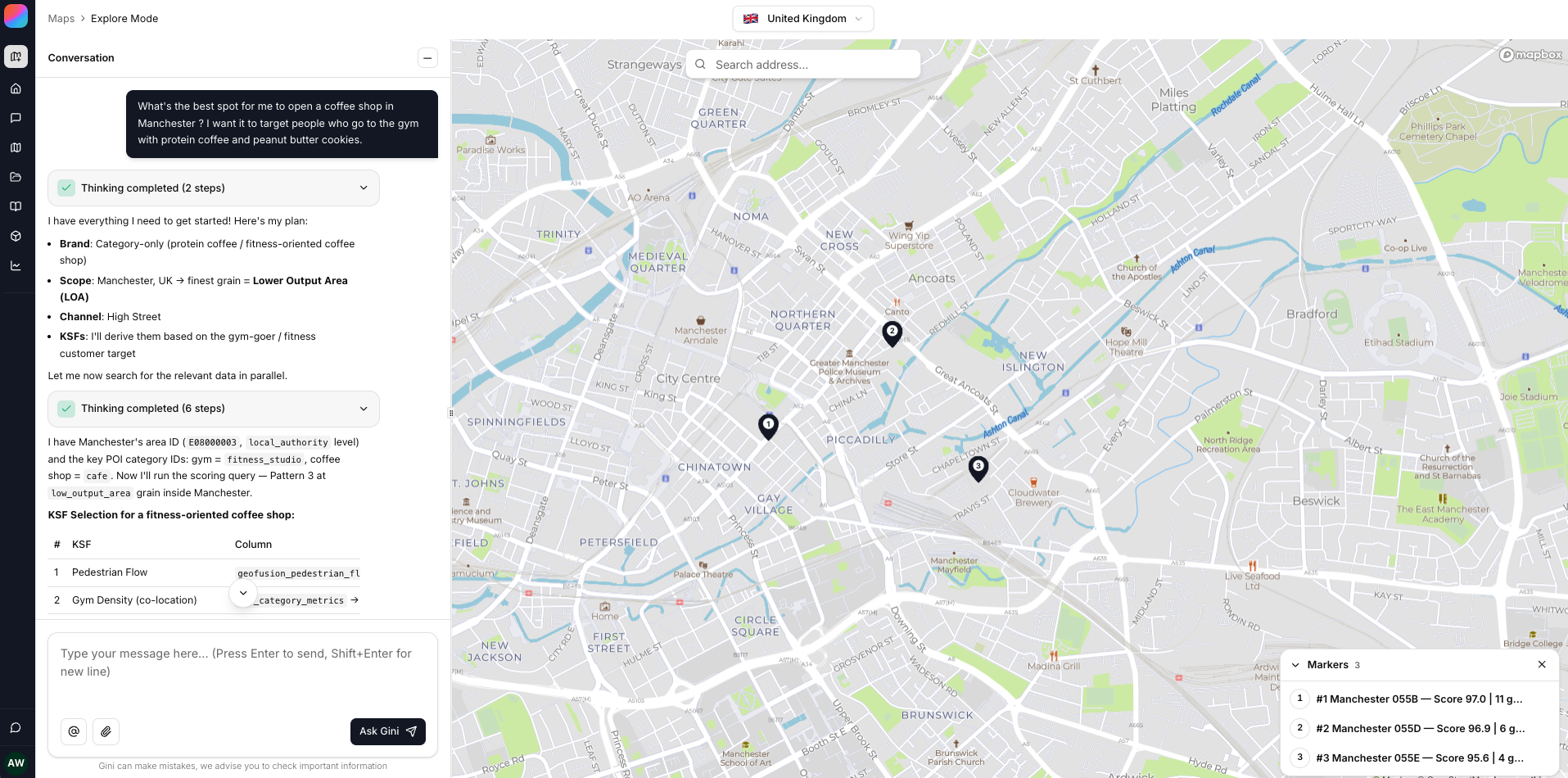
Kalibrate is a powerful tool, but it's drawbacks are apparent, especially when looking at territories like Europe where their expertise limits to consultancy. On the opposite end, Gini by MyTraffic has all the insights you could need (footfall, catchment area, visitor demographics, POI data, competitor density and revenue forecasting) live in 18 markets across Europe and the US at the same street-level accuracy, no matter your plan. No extra charges for extra usage.
You ask, in plain language, and the answer comes back with its reasoning attached. Pricing is published, starting at €249 a month, and there is a free trial for entrepreneurs. MyTraffic is a European company and Gini was architected to European data protection rules from the start, with every mobility signal anonymised and aggregated at source. For a legal team that has to sign the DPA, that is a shorter conversation.
Where each platform wins
Fuel and convenience networks in the USA
Kalibrate, without argument. Volume forecasting for a forecourt is a different discipline from retail footfall, and Kalibrate has been refining it for over fifty years. It also sells the pricing software that sits next to it, so pump price, shop margin and site strategy live in one vendor. Gini does not do fuel pricing yet.
European expansion planning across several markets
Gini analyses your criteria and your existing network and returns a territorial plan across countries, using the same measured insights such as footfall and competitive density in every one of them. No country-by-country data licensing, no statement of work, no waiting for a two-market pilot before you see the third.
Store network performance after the doors open
Gini for speed. Kalibrate's portfolio management module does handle relocations, closures and remodels, but answering "which five sites lost footfall this quarter and why" should take a sentence, not a report request. Gini can study store network performance at any moment and flag cannibalisation risk as your estate changes shape.
Teams without a GIS analyst
Gini. Kalibrate rewards a skilled operator with layer control, bulk reporting and custom spatial analysis. If nobody on your team can do that job full-time, most of what you licensed goes unused.
How to choose between Kalibrate and Gini by MyTraffic
Start with geography and your use case, because it decides most of this. If your growth is in Europe and you want to interrogate markets yourself rather than brief someone, Gini is the shortest path. If your estate is North American and you need cross-shop analysis plus broker deal flow in one system, Kalibrate is built for that shape of work.
Then ask what you are buying. Kalibrate is a platform licence plus data layers plus analytics, quoted per deployment, which is why total cost of ownership deserves a hard look before you sign. Gini is published pricing from €249 a month with a trial, so you can test the questions that matter to you before billing is even discussed.
Kalibrate alternatives: frequently asked questions
What does Kalibrate do?
Kalibrate sells location intelligence and site selection software plus fuel pricing software. Its main platform, Kalibrate Location Intelligence, handles site selection, revenue forecasting, cannibalisation analysis and portfolio management for retail, restaurant, grocery, healthcare and franchise brands, backed by an analytics services team.
How does Kalibrate pricing work?
Kalibrate does not publish rates. Its own FAQ says cost depends on how much third-party data you licence, how many seats you need, and whether analytics are included. Competitive Insights, the foot traffic product, requires a separate licence and is sold by US state. Expect a quote and a demo.
Does Kalibrate cover Europe?
Its fuel business operates in more than 70 countries. For retail, European work is typically delivered as an analyst-led engagement with data licensed market by market, as its own case study describes. The self-serve foot traffic product is sold at US state level.
Where does Kalibrate get its foot traffic data?
From Azira, named as the data partner in Kalibrate's Competitive Insights FAQ, averaging 35 to 40 million monthly active devices across 1.1 million pre-drawn geofences. Data refreshes every other week, with cross-shop figures updated monthly. Gini measures footfall on first-party signals instead.
Who are Kalibrate's main competitors?
In North America, Buxton, Placer.ai, SiteZeus and Esri ArcGIS come up most often, alongside the analytics practices Kalibrate itself acquired, Trade Area Systems, eSite Analytics and Intalytics. In Europe, Gini by MyTraffic is the closest comparison for measured footfall and multi-market expansion planning. We also compare Gini with the US foot traffic incumbent and with entry-level catchment tools.
600 companies trust us





Gini by MyTraffic
Gini by Mytraffic is a European AI-powered location intelligence tool built for business decision-makers. It uses GPS mobility data to analyze foot traffic, trade areas, visitor profiles, and market potential across multiple European markets. Rather than delivering dashboards to interpret, Gini answers questions in natural language and guides users through complex workflows.

Kalibrate
Kalibrate is a location intelligence and site selection software company headquartered in Manchester, UK, with roots in fuel and convenience retail going back to 1970. Owned by private equity firm Hanover Investors since 2017, it built its retail platform, Kalibrate Location Intelligence, from the acquisitions of Trade Area Systems, eSite Analytics and Intalytics, covering site selection, revenue forecasting, cannibalisation analysis and portfolio management.
Empower your decisisions with location intelligence
Get started now
Q&As
How do conversations work?
Conversations are used to run workflows and analyses in Gini. Each plan includes a monthly conversation allowance, with the exception of the "Plus" plan with unlimited credits. Unused conversations do not roll over to the next billing period.
Can I upgrade or downgrade my plan?
You can change your plan at any time. Upgrades take effect immediately, while downgrades apply at the next billing cycle.
What geographies are covered?
Covered geographies include coverage across Western Europe, Eastern Europe, Scandinavia, Portugal, and the DACH region.
How does AI simplify the user experience in Gini?
Gini is designed as an interface that speaks the language of the business. AI helps structure complex questions, guide analysis, and surface insights—making advanced territorial intelligence accessible without sacrificing depth.
How do Gini workflows handle complex questions so quickly?
Gini workflows structure complex analyses into guided, end-to-end processes. By embedding best practices, data, and AI, they turn what used to take weeks into decision-ready outputs delivered in minutes.Direct integrations with major language models on the market also provides flexibility and performance.
What kind of outputs does Gini produce?
Gini goes beyond dashboards. Through its Artifact Factory, it produces concrete, shareable outputs: executive summaries, analyses, and deliverables designed to support real decisions.
Can we use our own data in Gini?
Yes. Gini allows you to bring your own data directly into the platform—either through direct inputs or API connections—combining internal data with Place DNA to unlock deeper, decision-ready intelligence.
Is Gini dependent on a single AI model or provider?
No. Gini is model-agnostic by design. It orchestrates multiple AI models and providers to ensure each task uses the most appropriate intelligence—without lock-in.
Why could some requests be really slow?
Our infrastructure is optimized for high-performance spatial queries. You get deep-dive reports in seconds that used to take consultants weeks. Key point: Before, it was a consulting service that took on average 10 days, now it takes 7 minutes.
Is all data uploaded or added to gini freemiun fully confidential and securely handled?
Yes, all data uploaded or entered into GINI (including the freemium version) is treated as confidential and handled securely.
MyTraffic applies strict technical and organizational measures to protect data, including secure hosting infrastructure, restricted access controls, and encryption.
Any content provided by users (such as prompts or uploaded documents) remains the property of the user and is processed solely for the purpose of delivering the service.You can find more details about our data protection and confidentiality commitments in our GINI Terms of Service. We can also provide, upon request, additional documentation regarding our data governance, security, and privacy framework