


.jpeg)
.jpg)

Follow us on
Pop Mart stores in France, Germany, and the UK saw an average 15% increase in monthly footfall during the Labubu craze, based on two years of location data analyzed by Gini by Mytraffic. Visitors traveled further to get there. Repeat visits rose. And even after the trend faded, traffic stayed 10% above pre-craze levels. This is what happens when a social media moment becomes a destination.
What is Labubu, and why did it take over?

Labubu is a monster-inspired collectible character created by Hong Kong artist Kasing Lung and sold globally by Pop Mart, the Beijing-based designer toy company listed on the Hong Kong Stock Exchange. The character, known for its jagged smile and plush attachable form, was not new in 2024. Pop Mart had carried Labubu figures for years. What changed was a single moment: in April 2024, K-pop superstar Lisa from BLACKPINK posted a photo on Instagram showing a Labubu clipped to her designer bag. The post reached tens of millions of followers within hours.
What followed was a textbook viral loop. Fans bought Labubu figures to replicate the look. Influencers posted unboxing videos. Limited editions and short-run drops created scarcity. Resale prices on secondary markets like StockX and Xianyu climbed well above retail. Each scarcity event fed another wave of social content, which fed another wave of demand. By late 2024, Labubu was being discussed in fashion media, mainstream press, and retail industry reports alongside questions about what it meant for physical stores.
Pop Mart's own financial results reflect the scale. According to the company's FY2024 interim report, revenue grew 93% year-on-year in the first half of 2024, driven in large part by The Monsters product line, which includes Labubu. Overseas revenue more than doubled. The brand opened flagship stores in Paris, London, and Berlin, and reported sustained queuing at European retail locations throughout Q4 2024 and into Q1 2025.
The retail question, the one that matters for anyone running physical stores, was never whether Labubu was popular online. It was whether that popularity actually moved people through doors.
Did the Labubu craze actually bring more people into stores?
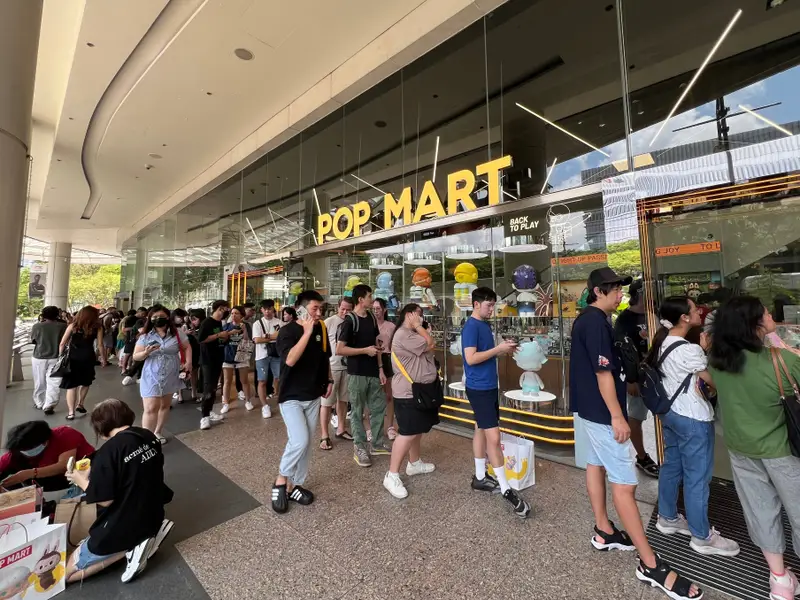
Yes, by a measurable and consistent margin.
Gini by Mytraffic analyzed footfall data across Pop Mart locations in France, Germany, and the United Kingdom over a two-year period from January 2024 through December 2025, comparing monthly visitor volumes before, during, and after the peak of the Labubu trend. The Labubu craze period is defined as October 2024 through May 2025, aligned with the surge in social mentions, limited-edition drops, and mainstream press coverage across European markets.
Before the craze, Pop Mart stores averaged approximately 1,050,000 visits per store per month across the three markets. During the craze, that figure rose to approximately 1,210,000 visits per store per month, a 15% increase sustained across six consecutive months, not a single spike around a launch event.
For context, a 15% sustained lift in monthly footfall is significant by any retail benchmark. According to Sensormatic Solutions' 2024 Global Shopper Trends Report, average year-on-year footfall growth across European specialty retail in 2024 was 1.3%. Pop Mart's Labubu-era performance was roughly ten times that baseline.
The data makes one thing clear: the online buzz did not stay online.
Which markets felt the most impact, and why did results differ?
The effect was real in all three markets, but the size of the impact varied in ways that tell retailers something important about how viral trends interact with local conditions.
France led with 15.9% monthly footfall growth and Germany followed closely at 16.0%. The UK showed a more moderate increase of 11.6%. The France and Germany figures are stronger, and the likely explanation is structural. Both markets have higher urban population density concentrated around major retail nodes, and Pop Mart's flagship locations in Paris and Berlin sit in high-footfall shopping corridors where incremental consumer motivation to visit translates directly into higher absolute visitor counts. The Paris location on Avenue des Champs-Élysées and the Berlin location in the Mitte district both benefit from existing tourist flows that amplify any trend-driven demand.
The UK's lower growth rate likely reflects two factors. First, Pop Mart's UK store network is smaller and more concentrated in London, meaning geographic reach is more limited. Second, the London market has a higher proportion of international tourist visits to begin with, which may dilute the percentage lift from a domestic social media trend.
The broader lesson for retailers: a viral trend does not hit all your locations equally. Urban flagship stores in high-density markets absorb trend-driven demand better than suburban or secondary-city locations. If you are planning a campaign around a cultural moment, the stores with the most to gain are not necessarily the ones with the lowest baseline traffic.
Were these planned trips or impulse purchases?
This is the most strategically important finding in the data, and the one that most challenges the assumption that social media trends only drive casual or opportunistic retail behavior.
During the Labubu craze, the average travel distance of visitors to Pop Mart stores increased significantly compared to the pre-craze baseline. People were not discovering Labubu because they happened to walk past a store. They were making a decision to travel to a specific location to find a specific product. In retail analytics terms, Pop Mart shifted from a discovery-mode retail experience to a destination-mode one.
This distinction matters because it changes the economics of a viral moment. An impulse purchase by a nearby shopper has low lifetime value and low repeat probability. A planned trip by a motivated collector or trend-following consumer has much higher engagement potential. The person who traveled 45 minutes to find a Labubu figure is far more likely to sign up for the Pop Mart loyalty program, follow the brand on social media, and return for the next drop.
Did the craze build lasting loyalty, or was it a one-time spike?
The repeat visitor data is where the Labubu story stops being a case study in viral marketing and starts being a case study in brand building.
In France and Germany, repeat visitor rates rose during the craze period. These numbers indicate that a meaningful portion of the new visitors who came to Pop Mart for Labubu came back again during the same trend period, most likely for subsequent limited releases, restocks, or complementary products. The UK's slight decline in repeat visits is consistent with the interpretation that a higher proportion of UK visitors during the craze were one-time tourists rather than local consumers building a relationship with the brand.
More important than the repeat visit data during the craze is what happened after it.
Once the peak social media attention had passed, monthly footfall settled at approximately 1,160,000 visits per store, 10% above the pre-craze baseline of 1,050,000, and it held. Pop Mart did not return to where it started. The craze expanded the brand's active customer base in Europe, introduced the store format to a new segment of consumers who had not previously visited, and established enough habit and loyalty that a substantial portion of those new visitors kept coming back. That is the difference between a viral moment and a strategic asset.
What does this mean for retailers planning their next campaign?
The Labubu data answers a question retailers have debated since the rise of social commerce: does online buzz translate into offline traffic, or is it all noise? The answer, at least when the product, the scarcity mechanics, and the cultural timing align correctly, is that it translates, measurably and durably.
But the more useful question for most retailers is not "can viral trends drive store traffic?" It is "how do I know if my campaign is doing it, and what should I do differently next time?"
Three things stand out from the Labubu analysis.
First, scarcity and sequential drops matter. The sustained six-month lift in footfall was not driven by a single launch event. It was sustained by repeated limited releases that gave motivated consumers a reason to return. Retailers who want a trend to drive store traffic over weeks rather than days need a product or campaign structure that creates multiple reasons to visit, not just one.
Second, the destination store effect is worth deliberately engineering. If your campaign is doing its job, you should see average visitor travel distance increase, not just total visitor count. A visitor who drove 30 minutes to reach your store has a fundamentally different relationship with your brand than one who walked in from the adjacent street. Measuring travel distance before and after a campaign tells you whether you are actually changing consumer behavior or just converting slightly more ambient footfall.
Third, the after-craze baseline is the real measure of success. A campaign that drives a spike and then returns traffic to its prior level has generated revenue but not growth. A campaign that leaves your monthly footfall 10% higher than it was before has actually expanded your market. The retailers who will benefit most from cultural moments are those who use them as acquisition events, designing the in-store experience during the craze period to convert first-time visitors into returning customers.
How do you measure whether a social media trend is actually driving traffic to your stores?
Measuring footfall lift from a campaign or cultural trend requires comparing like-for-like time periods across your store network, controlling for seasonal patterns, day-of-week effects, and any concurrent external factors like weather events or public transport disruptions.
The most reliable approach uses three measurement windows: a pre-campaign baseline covering at least 90 days, the active campaign period, and a post-campaign window of equal length to check whether the lift persists. Comparing only during versus before will tell you whether traffic rose. Comparing all three windows tells you whether anything changed permanently.
Travel distance data adds a second dimension. If total visitors rise but average travel distance stays the same, the traffic lift is likely coming from existing nearby customers visiting more frequently. If average travel distance rises alongside visitor count, new customers from further away are making intentional trips. The second scenario is more valuable for long-term growth.
Visitor segmentation by time of day and visit frequency provides a third signal. A craze driven by collectors and enthusiasts tends to show more morning and midday visits, higher-than-average repeat rates, and longer dwell times. A craze driven by casual curiosity or tourist behavior tends to show more weekend and afternoon visits, low repeat rates, and shorter dwell times. Knowing which dynamic is at work in your stores tells you whether your campaign is building a customer base or just generating temporary interest.
Gini by Mytraffic measures all three dimensions, across any store network in France, Germany, the UK, and six other European countries. The same analysis that tracked the Labubu effect across Pop Mart's European estate can be applied to any retailer, any campaign, and any cultural moment.
Frequently asked questions
Can a social media trend really drive measurable increases in store footfall?
Yes. The Labubu craze drove a 15% sustained increase in monthly store visits across Pop Mart locations in France, Germany, and the UK over a six-month period, based on footfall data analyzed by Gini by Mytraffic. The effect was consistent across markets and persisted after the peak trend period ended.
How do I know whether my marketing campaign is actually bringing people into my stores?
The most reliable method is comparing footfall data across three windows: before the campaign, during it, and for an equal period after. You also want to track average visitor travel distance, which rises when a campaign is attracting new consumers from further away rather than simply increasing visit frequency among your existing local base.
What is the difference between a viral spike and a lasting footfall lift?
A viral spike is a short-term increase in visits that returns to its prior baseline once the trend fades. A lasting lift means post-campaign footfall is permanently higher than pre-campaign levels. In the Pop Mart Labubu case, monthly footfall settled at 1,160,000 per store after the craze, compared to 1,050,000 before, a 10% permanent increase.
Which retail categories benefit most from viral social media trends?
The Labubu case suggests that collectible, limited-edition, and identity-expressive products have the highest conversion rate from online trend to physical retail visit. These are categories where scarcity is real, where ownership has a public dimension, and where the in-store discovery experience is part of the appeal. Fashion accessories, beauty, and specialty food and beverage share similar dynamics.
How do I measure footfall lift across multiple stores in different countries?
Gini by Mytraffic provides footfall measurement across 10 million locations in 9 countries with 10-meter accuracy. You can compare performance across your store network, segment by country or city, and track how a trend or campaign is landing differently in different markets, all from a single platform.
TL;DR
Social media trends do drive people into stores. The data is clear. But not every trend, not in every market, and not with the same longevity. The retailers who will turn the next viral moment into a lasting footfall advantage are the ones who measure it in real time, understand which stores are capturing it and which are not, and design their in-store experience to convert the new visitors they are acquiring into customers who keep coming back.
The Labubu effect was not an accident. Pop Mart had the product, the scarcity mechanics, and the store presence to capture what social media created. The question for your brand is whether you have the measurement infrastructure to know when that moment is happening, and how much of it you are actually catching.
That is exactly what Gini by Mytraffic is built to tell you.