


.jpeg)
.jpg)
.jpg)

Follow us on
The short answer: The best flagship locations combine a high-income, leisure-driven audience with controlled visibility, not maximum foot traffic. Gentle Monster's Paris flagship proves it, with 6.9 million annual pedestrians, a spending index of 126 on clothing, and Saturday traffic more than double weekday levels.
Gentle Monster opened its first European flagship in October 2025 at 132 Rue Vieille du Temple in Le Marais, Paris. The store looks nothing like a traditional eyewear shop. It is designed as an art gallery, with rotating installations, sculptural displays, and almost no traditional retail merchandising.
The location choice was not accidental. And reading the data behind it reveals a repeatable playbook that any retailer planning European expansion can use.
This article breaks down what the data shows about Gentle Monster's location decision, why Le Marais beats the Champs-Elysees for this kind of brand, and what signals to look for when you are evaluating your own expansion sites.
What does Gentle Monster's Paris flagship reveal about modern luxury retail strategy?
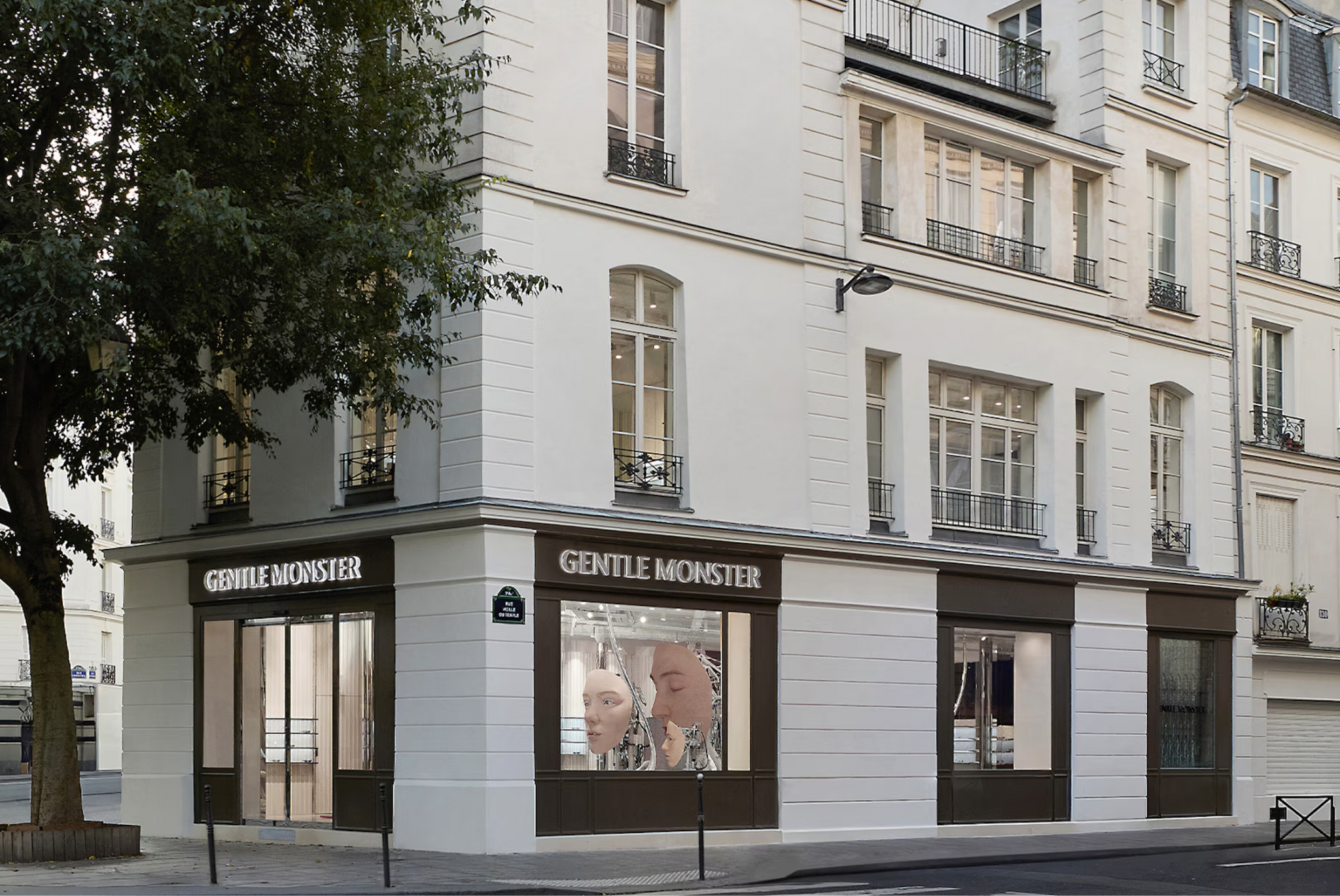
Gentle Monster is a South Korean eyewear brand founded in 2011. It sits in a specific category of what analysts now call "new luxury": premium, design-forward, experience-first. Its stores are known globally not for their product displays but for their art installations and theatrical environments.
The brand's 2025 European entry follows a pattern seen across Asian luxury brands expanding westward. According to Savills' research on new international entrants in Europe (2025), Asian brands including Pop Mart, Miniso, and Gentle Monster have historically concentrated their first European openings in London and Paris before diversifying into other cities. London and Paris remain the top priorities for cross-border brands due to their market size, affluence, and international visitor reach.
The store is not a point of sale. It is a cultural landmark. That distinction shapes every location decision the brand makes.
Location data from Gini by Mytraffic confirms the strategy. Benchmarked against five other luxury and premium brands in Paris, including Goyard in the 1st arrondissement and Dior in the 8th, Gentle Monster's Le Marais site scores third on pedestrian volume while placing first on audience quality alignment. The brand traded raw traffic for the right traffic.
Why do Asian luxury brands keep choosing Paris as their European gateway?

Paris is not just symbolically important for luxury retail. It is structurally useful for brands testing new markets. Savills' 2025 research on European retail expansion confirms that London and Paris remain the default entry points for cross-border brands seeking scale, customer density, international visitor reach, and brand exposure. For Asian brands specifically, Savills notes that those historically concentrated in these two cities are now beginning to extend into Berlin, Amsterdam, and Zurich only after establishing their European base in the gateway markets first.
The reasons are practical as much as they are reputational. Paris offers a dense, high-spending local population alongside significant international visitor traffic, a network of culturally distinct districts each with its own audience profile, strong media amplification for new retail concepts, and proximity to the European press and fashion industry.
Le Marais specifically has become the district of choice for brands that want cultural credibility without mass-market dilution. It hosts independent design galleries, concept stores, and long-established luxury ateliers side by side. The audience it draws is design-literate and high-income, but it is not the same audience you find on Rue du Faubourg Saint-Honore. It is younger, more curious, and more willing to discover new brands.
For Gentle Monster, which built its global reputation on surprise and discovery, this distinction matters enormously.
What does the foot traffic data actually say about the Rue Vieille du Temple location?
The raw numbers from Gini by Mytraffic's analysis of 132 Rue Vieille du Temple tell a clear story about what the brand was buying with this location.
The -4.3% year-over-year figure is worth pausing on. For a brand positioning itself as a stable cultural institution rather than a trend-chasing retailer, a mature and predictable corridor is an asset. The footfall data shows consistent traffic since 2020, with no extreme volatility. That is exactly what you want when you are signing a long-term lease and building a flagship that costs millions to fit out.
The Saturday-to-weekday ratio of 2.14 is the number that most clearly reveals the brand's positioning logic. Leisure-driven visits are qualitatively different from functional shopping trips. People who come to Le Marais on a Saturday are in discovery mode. They have time. They are open to new experiences. That behavioral profile is the target audience for an experiential retail concept.
How do you decode a brand's positioning from its store location?
The methodology used in this analysis compares a target site against benchmark locations used by brands with known positioning. This is one of the most direct ways to understand where a new brand is placing itself in the market, and it is a technique any retailer can replicate.
The six benchmarks used for Gentle Monster were Anne & Valentin (4th arrondissement, independent eyewear with a design-forward audience), Lacoste (4th arrondissement, accessible premium sportswear), LRG Eyewear (4th arrondissement, independent optical), Goyard (1st arrondissement, ultra-high-end heritage luxury), and Dior (8th arrondissement, global flagship luxury).
Placed in this competitive landscape, Gentle Monster's site sits clearly in the premium-cultural tier, closer to Anne & Valentin and the 4th arrondissement independents than to Goyard or Dior. The brand is not competing with the most traditional luxury corridors. It is staking out new territory in a district that signals cultural credibility rather than institutional prestige.
The benchmark approach gives you a map of the market, not just a snapshot of one address. It tells you who your neighbors are and what kind of customer they are already bringing to the street.
The spending index data reinforces this reading. Visitors and residents in the zone index significantly above the national average on categories that align with Gentle Monster's product and brand ethos.
This audience alignment is not a coincidence. It is what a benchmark-driven site selection process is designed to surface before a lease is signed.
What is "new luxury" retail and why does location prove it?
The traditional luxury playbook says: go to the most prestigious address, maximize visibility, and let the postcode do the branding. Avenue Montaigne. Bond Street. Via Montenapoleone.
The new luxury playbook says something different. Find the district where your audience already gathers, where the cultural conversation you want to be part of is already happening, and let the location reinforce the brand rather than substitute for it.
Gentle Monster's Le Marais site is a textbook execution of the second approach. The brand did not go to the 8th arrondissement. It went to the 4th, to a street that has hosted independent galleries, concept stores, and design-forward brands for decades. The address communicates taste, not just money.
This distinction matters operationally as well as symbolically. Mass-market locations bring mass-market crowds. For an experiential retail concept, that is a problem. You want visitors who are already in discovery mode, who have time, and who are predisposed to engage with what the store is offering. The leisure-driven traffic profile of Le Marais delivers exactly that audience.
The shift toward experience is not brand-specific. McKinsey's State of Fashion research (2025) finds that 70% of retail sales today are digitally influenced, and that physical stores have responded by carrying less stock and focusing more on conveying the DNA of the brand. The same research found that 75% of consumers surveyed said they are likely to spend more after receiving high-quality in-store service. The flagship, in this context, is a revenue tool, not just a marketing one.
JLL's European Retail research (November 2025) adds a sharper edge to this argument: physical stores demonstrate on average 10% greater profitability in fulfilling sales and processing returns compared to their digital counterparts. A well-located flagship is not a cost. It is a margin advantage.
How can retailers use location data to validate expansion decisions in Europe?
The analysis of Gentle Monster's Paris site is not just a case study. It is a method. Here is how to apply the same logic to your own expansion decisions.
Step 1: Define your positioning before you look at addresses
Know whether you are "new luxury", premium accessible, mass-market, or somewhere else before you start evaluating streets. Your positioning determines which signals to prioritize in the data. A fast-fashion brand optimizes for volume. An experiential concept optimizes for leisure-driven behavioral profiles.
Step 2: Build a benchmark set from brands with known positioning
Identify five to eight brands that represent the positioning space you are targeting. Find their store addresses in your target city. Use Gini by Mytraffic to pull the foot traffic, spending index, and visitor profile data for each site. This gives you a data-grounded map of where different positionings live in the city.
Step 3: Analyze the behavioral profile, not just the volume
Total annual pedestrians tells you very little on its own. The weekend-to-weekday ratio, the tourist-to-local visitor split, and the visitor dwell time tell you much more about whether the street's audience matches your brand. A ratio above 2.0 on weekend traffic typically indicates a leisure-oriented corridor. A high tourist share can dilute brand-building value even when volume looks attractive.
Step 4: Read the trend line, not just the snapshot
A street showing -4% year-over-year is not the same as a street in structural decline. Check the full trend since 2020. Volatility is a risk for flagship investment. Stability at a high base is an asset. Gini by Mytraffic's historical data lets you see whether a location's traffic profile is genuinely stable or oscillating.
Step 5: Cross-check the spending index for category alignment
A beautiful street full of leisure visitors who do not spend on your category is still the wrong street. Pull the spending index for your product categories and compare it against the national average. Look for an index above 115 as a minimum threshold for category alignment.
Gini by Mytraffic now covers nine countries across Europe, including Austria and Switzerland, enabling retailers to apply this methodology across new markets with the same depth of data available in established ones.
Frequently asked questions
What foot traffic data should I look at when choosing a retail location in Europe?
Beyond total annual pedestrians, prioritize the weekend-to-weekday ratio, tourist-versus-local visitor split, and year-on-year trend. A leisure-oriented corridor with a ratio above 2.0 on weekends typically delivers a higher-quality audience for premium and experiential retail formats.
How does Gini by Mytraffic's benchmark analysis work for retail site selection?
Gini by Mytraffic pulls foot traffic, visitor spending indices, and sociodemographic profiles for any address in its coverage area. You can compare a prospective site against existing brand locations to understand where it sits in the competitive positioning landscape and whether the audience profile matches your target customer.
Why did Gentle Monster choose Le Marais over more prestigious Paris addresses?
Le Marais delivers a high-income, design-aware, leisure-oriented audience rather than a mass tourist flow. For an experiential retail brand, behavioral alignment matters more than postcode prestige. The 4th arrondissement's spending index of 126 on clothing and 127 on jewellery confirmed the audience quality before the lease was signed.
What is Place DNA in the context of retail location analysis?
Place DNA is the combination of signals that define a location's commercial identity: its visitor profiles, footfall rhythms, spending behaviors, competitive environment, and cultural context. Gini by Mytraffic's analysis surfaces this identity in measurable form, so expansion decisions are grounded in what a place actually is, not just where it is on a map.
Which European markets does Gini by Mytraffic cover for retail expansion analysis?
Gini by Mytraffic covers nine countries across three continents, with recent expansion to Austria and Switzerland. The platform analyzes over 10 million locations at 10-metre accuracy, enabling consistent methodology across markets from Paris to Vienna.
TL;DR
Ready to apply this analysis to your own expansion? Gini by Mytraffic gives you the same depth of location intelligence used in this study, for any address in nine European countries. Start a 14-day free trial and run your first benchmark analysis today.