


.jpeg)
.jpg)

Follow us on
Why Lacoste opened a café, and what the data says about its location
Lacoste's first permanent café in Paris signals a calculated shift toward experience-first retail, backed by footfall data and demographic alignment. Here is what the numbers reveal, and what every retailer can learn from it.
Lacoste didn't open a café to sell coffee. The brand opened Café Lacoste at 16 Avenue Franklin Roosevelt, in the 8th arrondissement, to create a daily touchpoint with customers that goes far beyond a transaction. The space sits roughly 100 metres from the Lacoste flagship on the Champs-Élysées, and it is designed as a lifestyle extension of the brand, not a side project.
This matters to every retail professional reading this because the café is not an anomaly. It is the latest signal in a pattern that now includes Louis Vuitton, Dior, Ralph Lauren, Coach, Tiffany, Uniqlo, Prada, Zara, Carhartt, Aritzia, Capital One, and others. Lifestyle brands are becoming places. And the ones winning at it are choosing their locations with data, not instinct.
Using Gini by Mytraffic, we analyzed the Café Lacoste location to understand the strategy behind the opening, from demographic alignment to footfall dynamics and competitive intensity. The result is a clear example of experience-first retail grounded in location intelligence.
Why are lifestyle brands opening cafés instead of more stores?
The short answer: because a €7 coffee builds more brand equity per square metre than a new retail location ever could.
The experiential retail market reached $132 billion in 2025, up from $85 billion in 2023, according to market research from MetaTech Insights (2025). That is a compound annual growth rate above 15%, which makes it one of the fastest-moving segments in retail. And cafés are at the centre of this shift, particularly for lifestyle and premium brands that want to extend their identity beyond the product.
The list of brands that have opened branded cafés in the past three years reads like a who's who of global retail. Ralph Lauren was early with Ralph's Coffee, which opened on Fifth Avenue in 2014 and now operates locations from London to Tokyo. LVMH has embedded café concepts into Dior flagships in Seoul, Paris, and Dallas, remodelled the Tiffany Blue Box Café in New York with Michelin-starred chef Daniel Boulud, and opened the Louis Vuitton Café in Manhattan. Prada runs Marchesi 1824 locations in Milan and London and opened a pop-up café inside Harrods. Coach launched its first café in Jakarta in 2024 and now operates over a dozen internationally. Uniqlo opened its first North American café on Fifth Avenue in New York in March 2025. Zara debuted ZaCaffé in Madrid. Carhartt has a branded coffee shop in London. Aritzia runs 11 A-OK Cafes across Canada plus locations in Chicago and New York. Jacquemus staged a summer restaurant in Capri. Kate Spade tested a café pop-up in Dubai Mall. Even financial services got in on it: Capital One operates over 60 café-branch hybrids across the United States.
The pattern is clear. This is not a trend limited to luxury. It spans the full spectrum, from heritage couture to accessible fashion, from streetwear to banking. What connects them is a shared realization: physical retail needs to give people a reason to come, stay, and come back.
According to CNBC's January 2026 coverage of the trend, Coach reported double-to-triple-digit sales increases at stores where it added a café concept. That number is hard to ignore. The café does not cannibalise the retail space. It amplifies it. Customers who sit for a coffee spend more time in the brand's world, and that time converts into browsing, social sharing, and purchases that wouldn't have happened at a traditional point of sale.
As Michelle Baumann, Chief Strategy Officer at VML, told Marketing Brew (2025): a small purchase like a coffee increases customer dwell time, and the longer someone stays in a store, the more likely they are to browse and buy.
What does Café Lacoste's location reveal about its strategy?
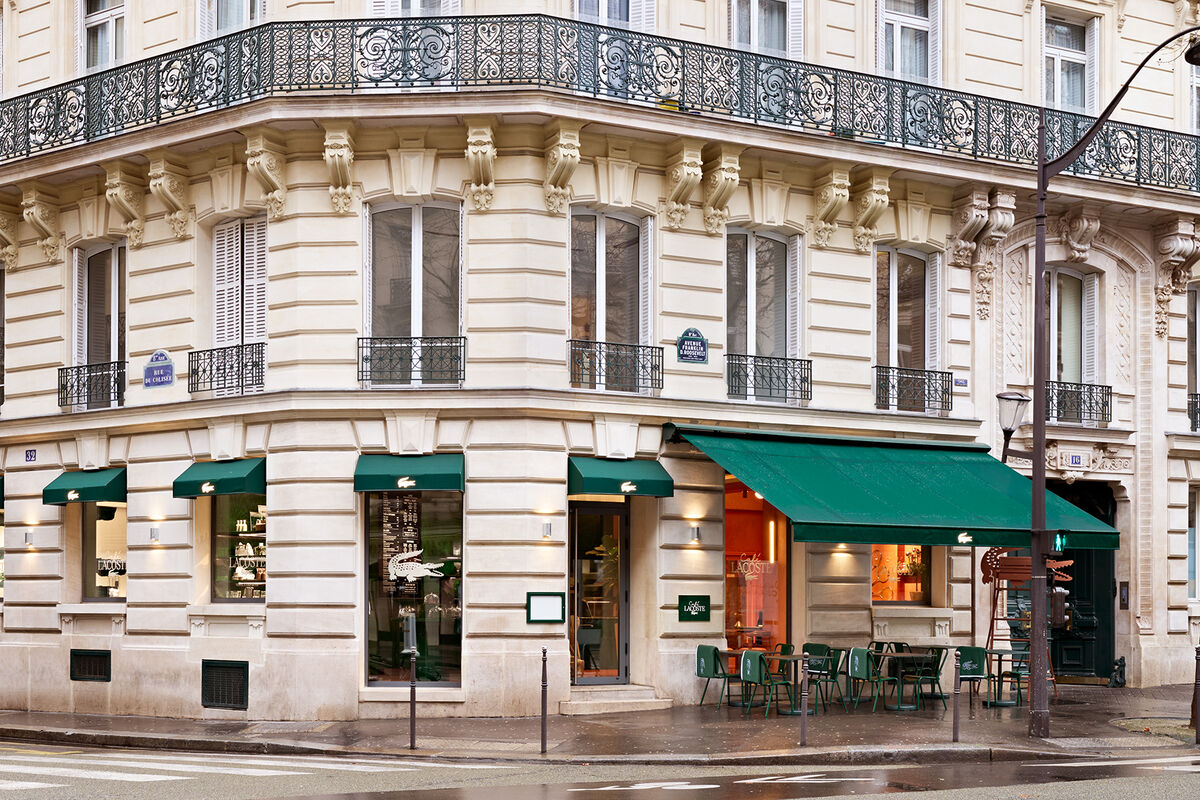
The café opened on February 5, 2026 in a 100-square-metre Haussmannian corner space at the intersection of Avenue Franklin Roosevelt and Rue du Colisée. It seats 65 people. It is open from 7:30am to 7:00pm, Monday to Saturday. The menu, developed with the Giraudi Group (the family behind Beefbar and two decades of high-end hospitality concepts), features artisan-roasted specialty coffees, inventive lattes in pistachio, vanilla, and ube, and a signature drink called L'Eau de Croco made with coconut water, matcha, and ginger.
But the real story is why this address, and not another.
We analyzed the location using Gini by Mytraffic, and the fundamentals are strong. The area sees approximately 12,000 visitors per day, with footfall peaking between noon and 6pm. That is a wide and active window, ideal for an all-day dining concept. The surrounding catchment area has strong purchasing power, which aligns directly with Lacoste's customer profile. And the proximity to the flagship store on the Champs-Élysées, just a short walk away, means the café and the store can feed off each other's traffic.
This proximity matters strategically. FashionNetwork reported that the building previously housed a Beef Angus Café concept also operated by the Giraudi Group, which effectively served as a test run for the partnership. Lacoste concentrated its retail and hospitality presence on a single geographic axis, reinforcing the idea that shopping and café culture can coexist in one neighbourhood loop. That reduces the risk of identity dispersion, a common failure mode when brands scatter their experiential concepts too far from their core locations.
The choice to partner with the Giraudi Group rather than managing the F&B operations in-house is also telling. Many retailers that have succeeded with branded cafés work with specialty partners. Ralph Lauren partners with La Colombe for its coffee. Capital One outsources operations to a third-party provider. Quality execution in hospitality is a different discipline than fashion retail, and brands that recognise this tend to deliver a more consistent experience.
How competitive is the area for food and beverage?
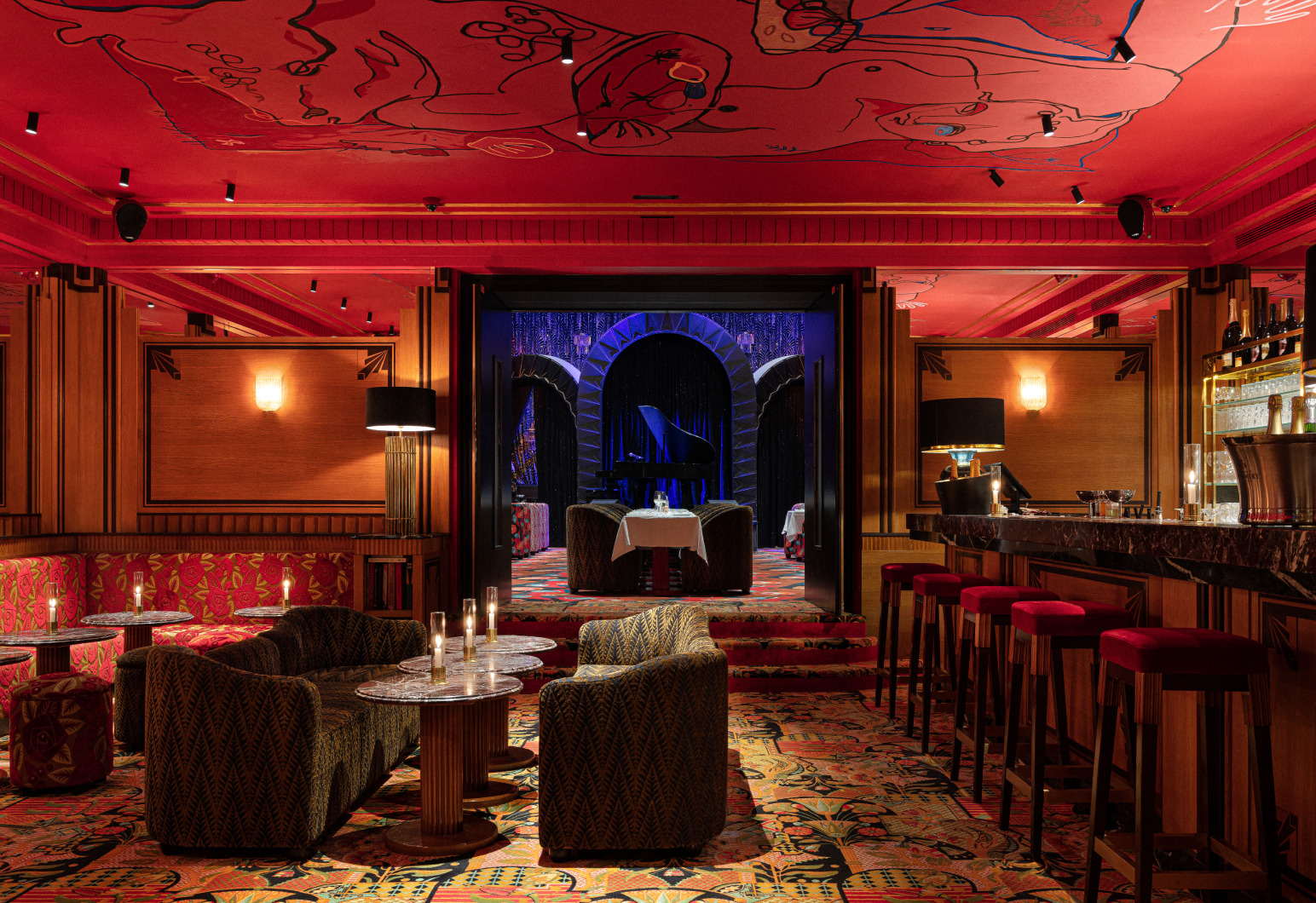
Within a 500-metre radius of Café Lacoste, the Gini by Mytraffic analysis identified 16 competing F&B establishments. That is a dense competitive environment by any standard.
But density in food and beverage is not necessarily a problem. It can actually be a validation signal. A high concentration of restaurants and cafés in a given area tells you that people already come there to eat, drink, and spend time. The demand exists. The foot traffic is confirmed. The habit is formed.
For Lacoste, the café does not need to be the destination that draws someone across the city. It needs to capture attention from the thousands of people already passing through the area daily. That is a fundamentally different challenge than opening a standalone restaurant in an unproven neighbourhood, and it is a much lower-risk one.
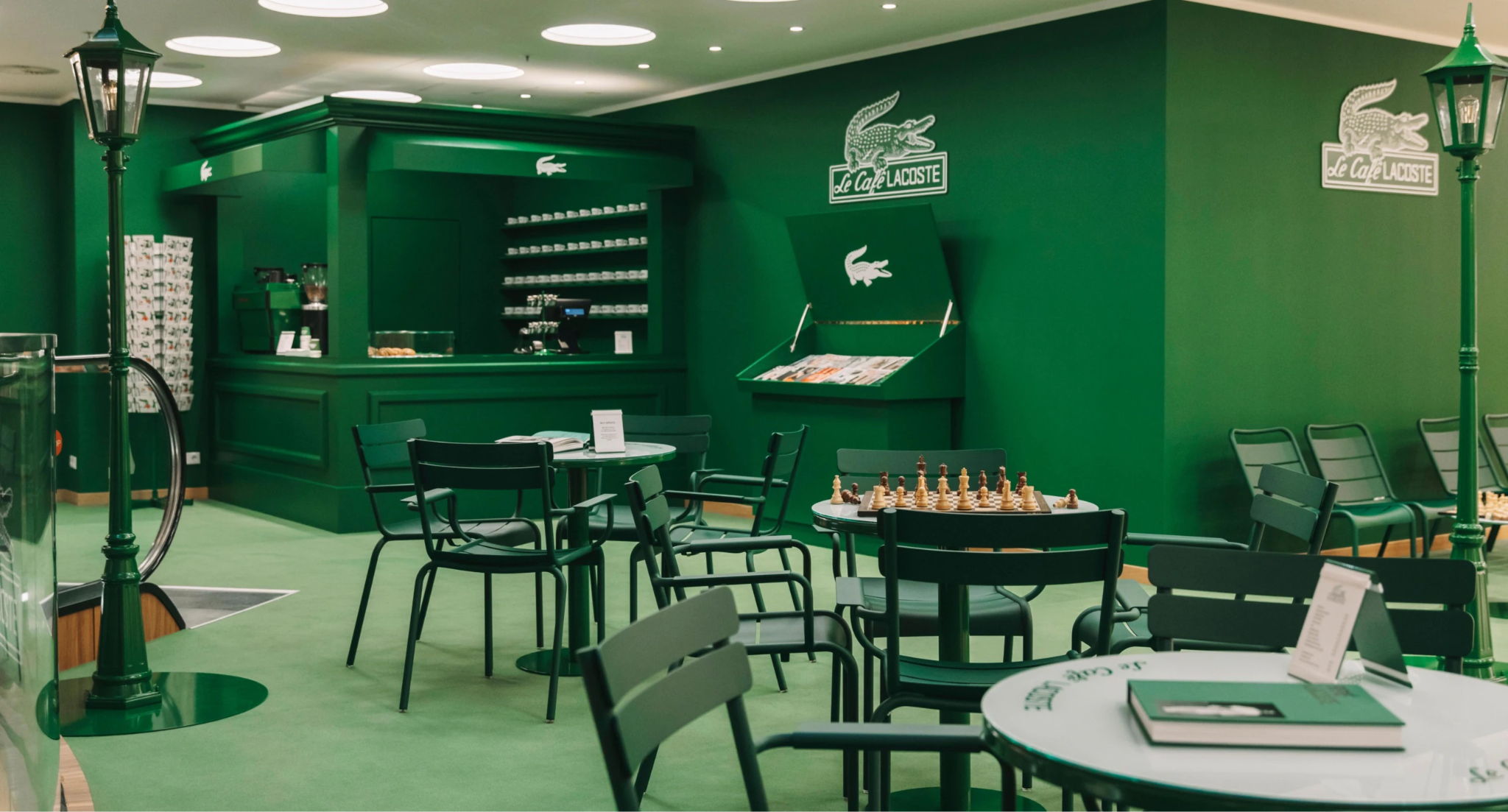
The risk, of course, is being just another café in a crowded zone. That is where brand identity becomes the differentiator. The interior of Café Lacoste uses a palette of deep green, off-white, and terracotta, with architectural lines inspired by tennis court geometry. The concept store section sells French porcelain stamped with the Lacoste name and a capsule textile collection. The signature Polo Cake is literally an edible version of the brand's DNA. Every detail signals that this is not a generic coffee shop. It is a branded living space.
What can retailers learn from this approach?
Café Lacoste is not an isolated experiment. It is one data point in a much larger pattern. When you zoom out and look at the full list of brands that have moved into hospitality, from Louis Vuitton to Uniqlo to Capital One, the lesson becomes unmistakable: experiential retail is no longer optional for brands that want to stay relevant in physical spaces.
Research from the International Council of Shopping Centers (ICSC, 2025) found that retail properties with experiential and retailtainment concepts saw a 25% increase in visits and a 22% jump in dwell times. Those numbers ripple outward, too. Traditional retailers near experiential anchors reported wanting to cluster closer to them because they pull foot traffic for the entire area.
The experiential retail market is projected to more than quadruple from $132 billion in 2025 to over $543 billion by 2035, according to MetaTech Insights. That is not a temporary trend. That is a structural shift in how physical retail works.
But here is the part that most analysis misses: the concept is only half the equation. The location is the other half.
A branded café in the wrong place will underperform no matter how beautiful the interior or how clever the menu. The brands that succeed at experiential retail are the ones that choose locations where the footfall, demographics, competitive intensity, and proximity to their existing retail presence all align. Lacoste picked a site with 12,000 daily visitors, peak hours that match an all-day dining format, high purchasing power in the catchment, and a flagship 100 metres away. That is not intuition. That is location intelligence at work.
For any retailer considering a similar move, here are the questions that matter most before committing to a location. How many people pass through the area daily, and when? Does the demographic profile match your customer base? What is the competitive density, and does it indicate existing demand or saturation? How close is the concept to your existing retail footprint? Can the two locations reinforce each other?
How does location intelligence change the way retailers plan experiential formats?
The traditional approach to opening a new retail concept relied heavily on gut feel, broker relationships, and a shortlist of "obvious" addresses. That approach works when you are making one bet every few years. It does not work when the market is moving this fast and the cost of a wrong location decision is this high.
Location intelligence flips the process. Instead of starting with a shortlist and then validating, you start with data and let the analysis surface the right addresses.
Gini by Mytraffic reads the Place DNA of any address, revealing its footfall patterns, visitor demographics, competitive environment, and catchment area characteristics. That turns a subjective site selection process into a structured, repeatable decision framework.
In the Café Lacoste case, the data confirmed what the brand probably suspected: Franklin Roosevelt was the right zone. But data does more than confirm. It also surfaces what you do not suspect. The competitive density, the precise peak hours, the demographic makeup of the catchment, these are the details that separate a good location from the perfect one.
This is especially valuable for retailers looking to replicate an experiential format across multiple markets. What works in Paris 8th arrondissement will not automatically work in Milan or New York. The fundamentals need to be re-evaluated for every new address. Place DNA changes from block to block, and the difference between a site that drives double-digit sales increases and one that quietly underperforms often comes down to variables that are invisible without the right data.
The shift toward experience-first retail is real. The brands that move fastest will win the best addresses. But speed without data is just expensive guesswork.
Frequently asked questions
What is experiential retail and why is it growing?
Experiential retail is the practice of designing physical retail spaces around immersive, memorable customer experiences rather than pure product transactions. The market reached $132 billion in 2025 and is growing at roughly 15% per year because consumers, particularly Millennials and Gen Z, increasingly prioritise experiences over products when choosing where to spend time and money.
How do branded cafés increase retail sales?
Branded cafés extend dwell time, which is the amount of time a customer spends in or near a retail space. Research consistently shows that longer dwell time correlates with higher conversion and larger basket sizes. Coach reported double-to-triple-digit sales increases at stores that added café concepts, and properties with experiential elements see an average 40% increase in dwell time compared to traditional formats.
What metrics matter when choosing a location for an experiential retail concept?
The five most important metrics are daily footfall volume, peak traffic hours, catchment area demographics (especially purchasing power), competitive density within a 500-metre radius, and proximity to existing brand locations. Analysing these factors together, rather than in isolation, gives a reliable picture of whether a site will perform.
How can mid-sized retailers compete with luxury brands on experiential formats?
You do not need a luxury budget to create a branded experience. The key is authenticity and location fit. Mid-sized retailers can start with pop-up concepts to test demand before committing to permanent spaces, partner with established F&B operators to reduce execution risk, and use location intelligence to identify areas where their target customers already spend time. The data shows that experiential retail benefits smaller and mid-ranked brands disproportionately, because the format gives them a differentiation edge they cannot achieve through product alone.