

.jpg)
.jpeg)


.jpg)

Follow us on
Where Should Tiendanimal Open Its Next Stores in Portugal?
Three parishes stand out for Tiendanimal's next expansion in Portugal: Massamá e Monte Abraão (Sintra), the historic centre of Guimarães, and Póvoa de Santo Adrião e Olival Basto (Odivelas). Each combines high residential density with limited direct competition and strong shopping centre proximity.
Tiendanimal opened its 30th store in Portugal in December 2025, at the Decathlon Montijo, after six new openings throughout that year alone. The brand, part of the Iskaypet Group alongside Kiwoko, now operates 50 sites across Portugal, with 16 in the Lisbon area, 26 in the Porto area, and eight in the south. The pace shows no sign of slowing.
The market justifies the ambition. According to Euromonitor International, Portuguese pet owners spent an estimated €612 million on their animals in 2023, and the market has been growing at 2 to 6% per year. Pet ownership in Portugal is among the highest in Europe: in 2020, 38% of households owned a dog and 32% owned a cat, figures that have continued to rise since the pandemic-era adoption wave. Portugal ranks among the top European markets for per capita pet food consumption, alongside Ireland and Hungary, reflecting a culture where pets are genuinely treated as family members.
This context makes location choice increasingly competitive. As more specialist retailers enter the Portuguese market, the gap between a well-chosen site and a poorly chosen one grows wider. The question isn't whether to expand. It's where.
What makes a high-potential location for a pet retailer?
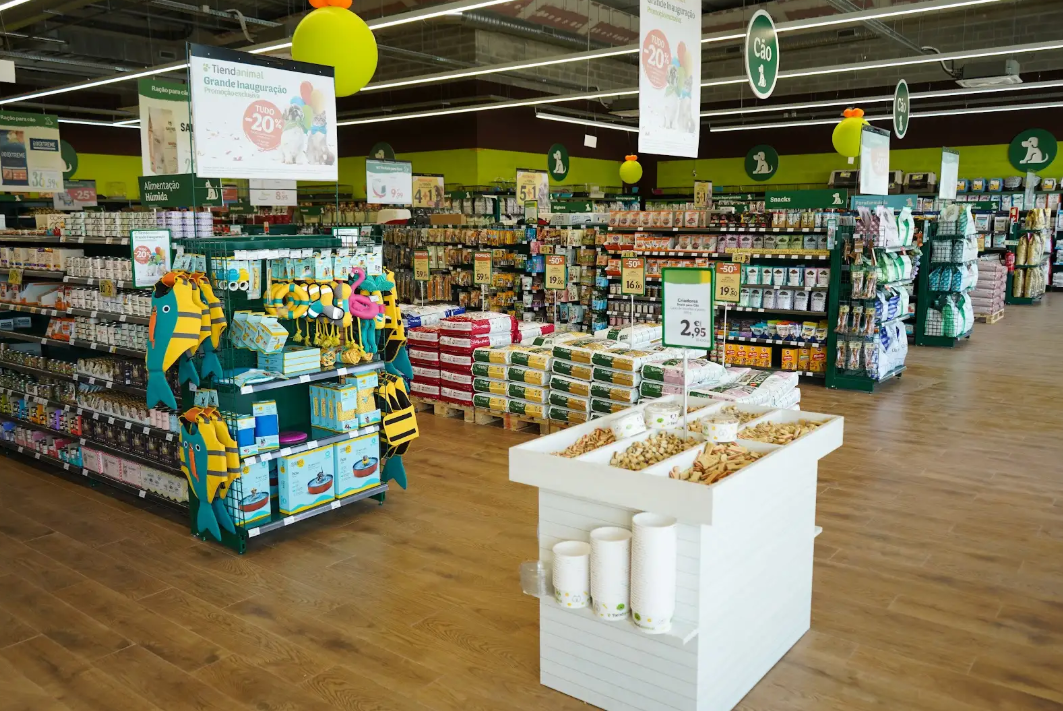
The strongest sites combine three signals: a large resident population, limited specialist competition within the catchment area, and an anchor retail environment that drives regular footfall.
Tiendanimal's store format, typically between 300 and 1,000 square metres, works best inside or adjacent to shopping centres and large retail parks. These formats benefit from passing traffic rather than relying on destination visits alone. A shopper who comes for groceries or a sports store can become a Tiendanimal customer, but only if the store is physically present and visible.
On the competitive side, the presence of two or fewer direct pet retail competitors within a parish is a strong positive signal. It doesn't mean zero competition: supermarkets carry pet food everywhere in Portugal, accounting for 65.6% of pet product sales by volume according to GlobalPETS data. But specialist pet retailers are a distinct purchase occasion, and white space at that level still exists.
Population density matters because pet ownership is broadly distributed across income groups and age groups. A parish with 15,000 residents per square kilometre generates significantly more addressable demand than a lower-density suburb, even if absolute pet ownership rates are similar.
Using Gini by Mytraffic, these three signals, population density, competitive mapping, and retail cluster proximity, can be assessed simultaneously across every parish in Portugal. Rather than evaluating sites one by one, expansion teams can rank the full map and focus resources on the locations that score highest across all three dimensions.
Which three locations show the strongest potential for Tiendanimal's next stores?
Massamá e Monte Abraão, Sintra
With 47,800 residents, a density of 15,500 people per square kilometre, and four competitors concentrated in one zone of the parish, Massamá e Monte Abraão presents a clear white space opportunity on its underserved side.
This civil parish sits within the Sintra municipality in the Lisbon metropolitan area. The competitive landscape here is not absent, but it is uneven. The four existing pet retail competitors are clustered near the parish's shopping centres, leaving residential zones on the opposite side with strong footfall but no nearby specialist offer. A new Tiendanimal site positioned in or near the underserved retail cluster would face limited direct competition while drawing from a dense, established residential base.
At 15,500 people per square kilometre, this is one of the most densely populated areas in the greater Lisbon region, which means the addressable market for daily and weekly pet care purchases is large. The presence of existing shopping infrastructure confirms that residents are already in the habit of doing their retail locally.
União das freguesias de Oliveira, São Paio e São Sebastião, Guimarães
The historic centre of Guimarães offers 7,860 residents, a density of 5,050 people per square kilometre, only two direct competitors, and an existing shopping centre, a combination that is harder to find in a secondary Portuguese city.
Secondary cities are often where the most interesting expansion opportunities exist precisely because fewer operators have prioritised them. Guimarães, a UNESCO World Heritage city in the Minho region with a strong local economy and active consumer culture, has seen limited pet retail investment relative to its population and purchasing power.
Two direct competitors is a low number for an urban parish with an established retail environment. The presence of a shopping centre confirms the infrastructure for a format-appropriate Tiendanimal store. The resident customer base, while smaller in absolute terms than Lisbon or Porto parishes, is concentrated and not yet well-served by specialist pet retail.
Póvoa de Santo Adrião e Olival Basto, Odivelas
With 18,800 inhabitants, a density of 7,150 people per square kilometre, only two competitors, and four nearby shopping centres, this Odivelas parish combines residential scale with commercial infrastructure and limited specialist competition.
Odivelas sits immediately north of Lisbon and is one of the more densely populated municipalities in the country. Póvoa de Santo Adrião e Olival Basto benefits from strong residential demand, good transport connections to central Lisbon, and a retail environment anchored by four shopping centres in close proximity. This is the kind of location where a Tiendanimal store benefits from multiple catchment areas pulling in different directions.
The combination of only two direct competitors with four commercial anchors suggests the parish has retail infrastructure that outpaces its current specialist pet retail supply. For a brand like Tiendanimal, which relies on shopping centre traffic and repeat visits for grooming and veterinary services, this is a strong foundation.
How do you apply this methodology to your own retail network?
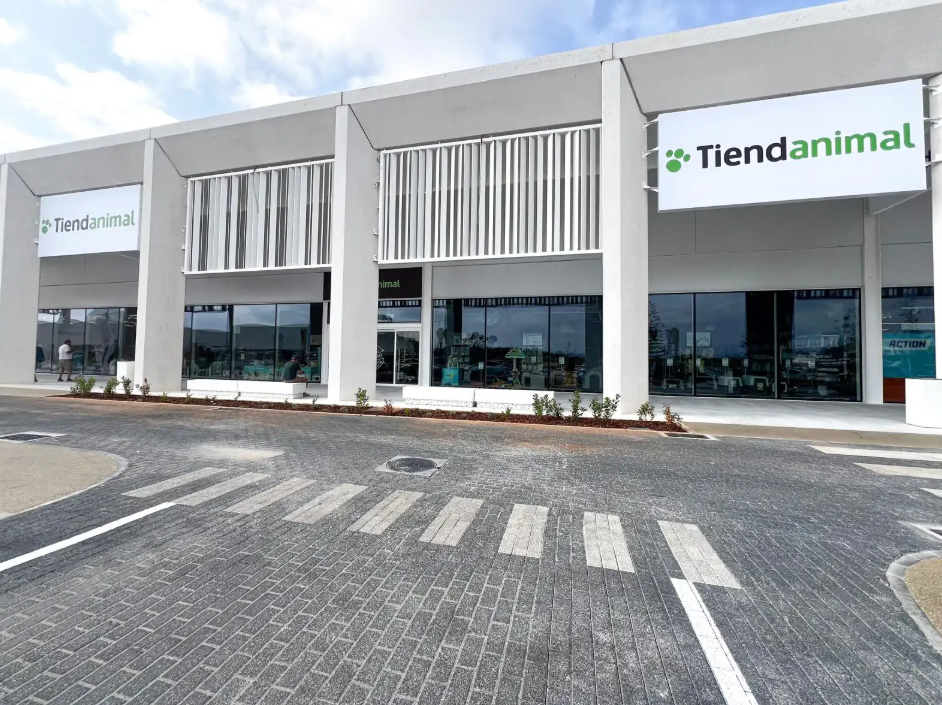
The framework used here applies to any retail brand planning expansion: define your key success factors, map the competitive landscape, score locations against your criteria, and focus investment where the gap between demand and supply is largest.
For pet retail specifically, the key success factors are consistent: residential density drives passive demand, competitor concentration identifies white space, and shopping centre proximity determines whether the store format works. These three variables are not unique to Tiendanimal. They apply to any specialist retailer whose purchase occasion is regular rather than occasional.
What changes between brands is the weighting. A veterinary clinic weights population density and proximity to residential areas more heavily than retail cluster proximity. A grooming salon looks at competitor concentration at a finer geographic level. A large-format pet superstore needs retail park scale that a neighbourhood shop does not.
Gini by Mytraffic runs this analysis at the parish level across all of Portugal, or any other market in Europe. The Site Selector workflow compares a prospective location against benchmark sites, surfacing the indicators that have historically predicted success for the brand. The Expansion Planner maps the full territory against defined criteria and returns a ranked list of opportunities, not just a map.
The result is a decision that takes days instead of months, with the data trail to justify it internally.
Frequently asked questions
How do you identify the right locations for a new retail store?
Start with your current best-performing stores and reverse-engineer what they have in common: population density, competitive context, retail environment, and catchment area profile. Those shared characteristics become your site selection criteria. Apply them across your target geography using location intelligence data to rank and shortlist parishes or zones before committing any resource to physical visits.
What data is most important for pet retail site selection in Portugal?
Population density and household composition data from INE, competitive mapping of existing specialist pet retailers, and proximity to shopping centres or large retail parks. Footfall data adds a further layer by confirming whether a retail environment is actively used, rather than simply present on a map.
What is the difference between site selection and expansion planning?
Site selection evaluates a specific address or zone against fixed criteria. Expansion planning starts from a blank map and identifies where gaps exist across a territory. For a brand like Tiendanimal actively expanding its Portuguese network, the expansion planning phase should come first, surfacing the top candidate zones, and site selection then focuses those findings on specific plots or retail units.
How does Gini by Mytraffic support retail expansion decisions?
Gini by Mytraffic combines socio-demographic data, mobility signals, competitive mapping, and footfall indicators across 10 million analysed locations in Europe. The Expansion Planner workflow transforms a set of brand-specific criteria into a ranked territory plan, and the Site Selector workflow benchmarks individual addresses against a brand's existing network. Both outputs are exportable as ready-to-share reports.