


.jpeg)

.jpg)

Follow us on
Yes, it should. Arc'teryx's UK and French stores attract similar numbers of visitors annually, but that surface similarity hides opposite growth trajectories, different audience profiles, and fundamentally different cross-store behaviour. Treat both markets the same way and you'll misread one of them, probably at significant cost.
This study uses location intelligence data to compare Arc'teryx's retail footprint across London and Paris, then draws out what it means for any premium brand planning its next international move.
Does footfall alone tell you whether a new market is worth entering?
No. Footfall volume is a starting point, not an answer.
Arc'teryx's UK and French stores post remarkably similar annual visitor numbers, with only a 12% difference in average footfall per store. But that number by itself would lead you to the same location strategy in both markets, and that would be a mistake.
UK average: 10.9 million visitors per store. France average: 9.7 million visitors per store.
The numbers look comparable. But footfall is not the same as momentum, and momentum is what determines long-term store performance. A location with 10 million visitors today and declining traffic is a fundamentally different investment from a location with 9 million visitors and rising traffic. Volume gives you a snapshot. Trend gives you the film.
For expansion teams evaluating new markets, this matters because lease decisions are typically five to ten years long. Signing on strong current footfall without understanding the direction of travel is one of the most common and expensive mistakes in retail site selection.
Why are Arc'teryx's Paris stores growing while London locations are declining?
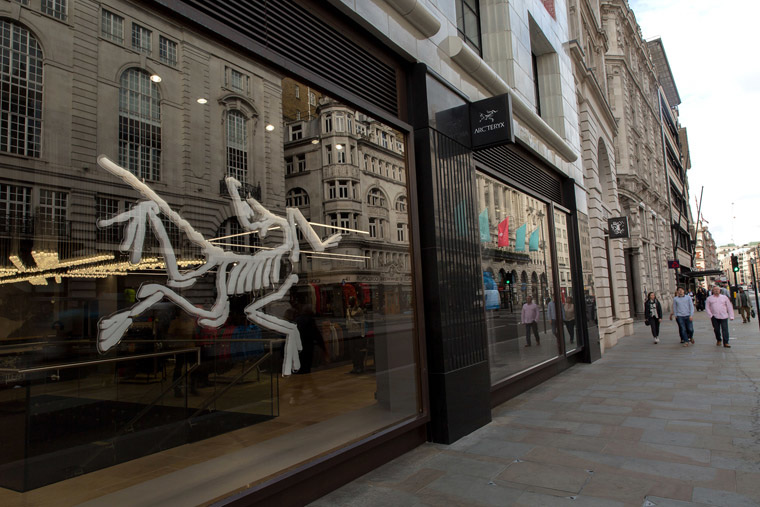
Paris stores posted positive footfall growth between 2024 and 2025. London stores declined in the same period, despite facing no meaningful increase in direct competition.
The divergence is not about brand strength or product. Arc'teryx is equally well-positioned in both markets. The difference is district typology.
Arc'teryx's Paris stores sit in trendy, lifestyle-oriented neighbourhoods with strong local loyalty and sustained tourist appeal. Le Marais, where Francs-Bourgeois is located, is one of the most-visited shopping districts in Europe, consistently gaining popularity as a destination for both Parisians and international visitors. The Madeleine area benefits from proximity to major tourist routes while retaining a premium local commercial character.
Arc'teryx's London stores, by contrast, are located in high-traffic central areas that attract footfall from transit and tourism rather than from destination shopping. These locations perform strongly in absolute terms but are more exposed to the volatility of central London's changing commuter and visitor patterns, which have not fully recovered to pre-2020 levels in some corridors.
The lesson for expansion planners is that the same brand can perform very differently depending on whether its stores are placed in districts that are gaining cultural and commercial momentum versus districts that are simply busy. When you select a location, you are not just selecting a volume of visitors. You are selecting a trajectory.
According to CBRE's European Retail Real Estate Market Outlook 2024, prime pitch footfall across European capitals has diverged sharply since 2022, with lifestyle-led mixed-use districts outperforming traditional high streets by an average of 8 to 12 percentage points in annual footfall growth. Arc'teryx's data reflects exactly this structural shift.
Do "affluent customers" mean the same thing in every market?
No, and this is where most premium brands get their international audience analysis wrong.
At first glance, France appears to attract wealthier Arc'teryx shoppers. Average purchasing power per capita in the catchment areas of French stores is higher than in the UK equivalent.
But a deeper cut of the data tells a different story.
UK locations attract a higher share of Arc'teryx's core target customer, the genuinely high-income shopper, despite having a lower average purchasing power across the full catchment. London's wealth is concentrated. Paris's wealth is more broadly distributed across a larger population, which raises the average but dilutes the high-income segment.
There is a second layer to this. Arc'teryx products are priced equivalently in both markets once currency conversion is applied. But London residents benefit from higher city-level purchasing power relative to living costs, making premium outdoor gear relatively more accessible to the UK customer base. A £400 jacket represents a smaller proportion of take-home income for a central London professional than the equivalent amount does for a central Paris professional at a comparable career stage.
For premium brands doing international feasibility analysis, the implication is clear: average purchasing power at the catchment level is a weak proxy for your actual addressable customer. You need to look at the concentration of your specific income segment in the target catchment, not the mean of the full population around it.
Does a multi-store network behave differently across countries?
Yes, and it directly affects how you should sequence your expansion and manage cannibalization risk.
When Arc'teryx's UK and Paris stores are compared on the share of visitors they have in common, the difference is striking.
UK customers move between Arc'teryx stores at significantly higher rates. King Street shares more than two thirds of its visitors with Piccadilly. In Paris, the two stores operate far more independently, with much lower overlap.
Several factors explain this. UK stores are in closer geographic proximity. Central London's retail districts are more interconnected, with consumers moving fluidly across them in a single visit. Store formats in the UK may also encourage multi-visit behaviour for different product categories or experiences.
The strategic implication is not simply about distances on a map. High cross-store visitor overlap means you are serving the same customers from multiple locations, which is expensive and creates real cannibalization risk. It may justify a differentiated format or product mix strategy between stores. Low overlap, as seen in Paris, suggests the two stores are genuinely serving different catchments, which is the ideal scenario for network expansion: each location adds incremental reach rather than dividing existing demand.
McKinsey's State of Fashion research confirms that sportswear generated 42% of positive economic profit across the entire fashion industry, a concentration that underscores how critical precise network strategy is in the category: with this much profit at stake, the difference between a well-chosen and a poorly-chosen location compounds over the life of a lease.
For any brand planning a second or third store in a new international market, understanding the visitor overlap between planned locations before signing leases is one of the highest-value analyses an expansion team can run.
Why are premium brands accelerating international expansion right now?
The window is open, and the brands moving fastest are taking the best locations.
Three structural shifts are driving international retail expansion for premium consumer brands right now, and they affect Arc'teryx as much as they affect any brand considering its first move into a new European market.
The DTC acceleration is forcing physical expansion
For most of the last decade, premium brands invested heavily in direct-to-consumer e-commerce and pulled back from wholesale. Arc'teryx has been one of the most disciplined operators of this strategy, posting over €2 billion in sales in 2024 and opening more than 30 new stores in that year alone. The logic is well established: owning the customer relationship generates higher margins, more data, and stronger brand control than selling through third-party retailers.
But DTC at scale requires a physical network. Flagship and mono-brand stores are not just sales points. They are the physical expression of the brand, the place where new customers encounter the product for the first time, and the infrastructure that underpins returns, repairs, and community events. McKinsey's State of Fashion 2025 confirms that challenger sportswear brands now identify DTC as their primary expansion route, while larger established brands that previously pulled back from wholesale are reconsidering it, reflecting how central the DTC channel has become to premium sportswear growth strategies.
For a brand still in the early stages of building its European network, this creates urgency. The locations that anchor a market, the highest-footfall pitch in a city's premium retail district, go to the brands that move first. Waiting means accepting second-tier locations or, in some cases, finding the best sites already locked up by competitors for the next decade.
European premium retail is growing, and the geography matters
Europe is not a single market. This matters more for premium outdoor and lifestyle brands than for almost any other category, because cultural alignment between the brand's values and the local consumer's lifestyle identity is a genuine driver of purchase intent.
Euromonitor International's Global Apparel and Footwear 2024 report projects that the premium outdoor and lifestyle apparel segment in Western Europe will grow at a compound annual rate of 6.2% through 2028, outpacing the broader apparel market by more than three percentage points. That growth is not evenly distributed. Markets like Austria, Switzerland, and the Nordic countries, where outdoor culture is embedded in everyday life rather than positioned as a niche interest, are outperforming the European average by a significant margin.
For a brand like Arc'teryx, this creates a specific and time-limited opportunity in markets where the product-to-lifestyle fit is exceptionally strong but where physical retail presence is still limited. Being the first premium technical outdoor brand with a properly resourced mono-brand store in Vienna or Zurich means something very different from opening a third store in a city where the market is already competitive and the best pitches are taken.
Physical retail is recovering faster than expected in premium districts
The widely predicted permanent shift away from physical retail has not materialised for premium brands. According to CBRE Investment Management's retail analysis (Q3 2024), European retail vacancy stood at 6% as of Q3 2024, back below pre-pandemic rates after peaking above 10% in 2021, driven by renewed demand from premium and experiential brands prioritising physical presence .
For brands that are still in the planning stages of their European expansion, this has a direct implication. The supply of genuinely excellent retail locations in Europe's premium districts is tightening. The brands that did their site selection work two or three years ago and moved quickly when opportunities arose are now operating in locations that are not currently available to latecomers. Expansion is not only a question of whether to move. It is a question of when.
For first-time international movers, the risk of acting too slowly is now at least as significant as the risk of acting too fast.
How do you execute a cross-border retail expansion without getting it wrong? A 9-step guide for expansion managers
A store opening is visible. The work that determines whether it succeeds is invisible, and it happens months or years before the ribbon is cut. Here is the process that separates sustainable international expansion from expensive mistakes.
Step 1: Clarify strategic intent before you look at a single location
Every expensive expansion mistake starts with the same error: jumping to location analysis before clarifying what the expansion is actually trying to achieve.
Before opening a spreadsheet or visiting a city, define three things precisely.
Your expansion objectives: Are you entering a new market to build brand awareness, to capture an identified concentration of your target customer, to respond to competitive moves, or to extend a network that already has momentum in an adjacent geography? The answer changes almost every downstream decision.
Your risk appetite: A brand opening its first international store has a very different tolerance for uncertainty than a brand adding a fifth European market to an established network. Define how much financial exposure you are willing to accept per location, what the acceptable payback period is, and what failure looks like before you start.
Your operational limitations: Staffing models, supply chain logistics, lease negotiation capacity, and local regulatory compliance all have real constraints. A location that is commercially excellent but operationally unmanageable is not a good location.
Step 2: Identify what actually drives performance in your existing network
The most reliable predictor of what will work in a new market is a rigorous analysis of what already works in your current one.
Map the characteristics of your highest-performing existing stores: the footfall volumes they sit in, the income profile and lifestyle characteristics of the catchment population, the competitive context, the store format and size, the proximity to anchor brands and destination retailers. Do the same for your underperformers and look for the pattern that separates them.
Arc'teryx's own data illustrates this clearly. The brand's Paris stores are outgrowing its London locations not because Paris is a better market in aggregate, but because the specific districts chosen in Paris align more closely with the lifestyle-led, community-embedded characteristics that drive premium outdoor brand performance. If you can identify your version of that insight from your existing network, it becomes the filter for every new location decision.
Incorporate competitor analysis here as well. If a direct competitor has been operating in your target market for several years, their store performance data is one of the most valuable benchmarks available to you.
Step 3: Select markets before you select locations
Europe is not one decision. It is nine or ten distinct decisions, each with its own risk profile, regulatory environment, logistics infrastructure, and cultural fit with your brand.
Prioritise markets where at least three of the following conditions are true: your brand already has organic awareness or an established e-commerce customer base; there is a cultural or lifestyle affinity between your product and the local consumer; logistics and regulatory complexity are manageable within your operational model; competitors have already demonstrated that the business model works in that country.
The last point matters more than most brands acknowledge. A competitor successfully operating in a market does not mean the opportunity is gone. It means the risk is partially de-risked. You are no longer guessing whether the category works there. You are asking whether you can execute better or differently enough to capture market share.
Avoid the trap of selecting markets based on macro indicators like GDP per capita or total retail market size. These are useful background context but poor predictors of whether your specific product and brand positioning will resonate with the specific customer segment you are targeting in that specific city.
Step 4: Identify high-potential areas within your target market
Once you have selected a country, the unit of analysis shifts from the national market to the city, and then from the city to the district.
The factors that matter at this stage: commercial hotspots with sustained high footfall, neighbourhood characteristics that align with your brand positioning, sociodemographic concentration of your target income and lifestyle segment, and genuine consumer demand for your product category as evidenced by existing competitor performance and category-level purchase data.
This is where quantitative location intelligence tools become genuinely valuable. The difference between a district with 10 million annual visitors concentrated in a two-block area and one where the same footfall is diffused across a large catchment is invisible in aggregate data but decisive for store performance. Getting this right requires address-level analysis, not city-level averages.
Step 5: Compare shortlisted locations in depth
After identifying promising areas, move to a rigorous side-by-side comparison of specific sites.
For each location under consideration, analyse: the competitive set and anchor retailers within a 200-metre radius, market saturation for your category in the immediate vicinity, long-term footfall trend over at least three years rather than a single recent snapshot, and the demographic composition of the catchment area with specific attention to the concentration of your core target segment rather than the population average.
Rank locations against your predefined criteria from Step 1 and Step 2. The ranking should be quantitative, not impressionistic. If two expansion team members visit the same two locations and come back with different assessments, the problem is usually that the evaluation criteria were not specific enough. Fix the framework before visiting the sites.
Step 6: Source and compare lease offers with full financial modelling
Once you have identified your target zones, begin the process of identifying available lease opportunities and modelling the commercial case for each.
The comparison between specific lease offers is not only about the monthly rent. It requires a full view of the commercial conditions: the lease term and break clauses, the fit-out cost and who bears it, any rent-free periods, the service charge and rates, and any turnover rent or step-up clauses that affect the long-term cost.
A location with a higher base rent and better footfall characteristics can produce significantly better unit economics over a ten-year lease than a cheaper location with weaker traffic. Model both scenarios explicitly. The question is not which lease is cheaper today but which location generates better revenue per square metre over the lease term.
Step 7: Validate on the ground before you sign
Data analysis tells you what is measurable. A site visit tells you what is not.
Visit each shortlisted location at multiple times of day and on different days of the week. Observe actual foot traffic flow, not just volume. Assess visibility from the street: whether the frontage is legible from the main direction of pedestrian movement, whether there are competing visual distractions, whether the entrance is accessible or obstructed. Evaluate the quality of the retail environment: the condition of neighbouring units, the cleanliness and management of the public realm, the presence or absence of vacancy in the immediate vicinity.
Talk to adjacent retailers where possible. They will tell you more about the real commercial dynamics of the location in thirty minutes than you can learn from any dataset.
Step 8: Align lease finalisation, build-out, and launch preparation simultaneously
Once a location is selected, three workstreams run in parallel and none of them can wait for the others.
The lease negotiation should aim to secure favourable terms while the build-out is being designed, because the design affects the fit-out cost which affects the lease economics. The build-out preparation should begin as soon as heads of terms are agreed, not after the lease is signed, because in most markets the permitting process adds weeks or months to the timeline. The launch strategy, including local PR, partnerships with relevant community organisations, and the hiring and training of the store team, should be live before the store opens, not after.
The brands that execute international openings well treat the store opening not as the end of the project but as the beginning of the customer acquisition phase. The weeks immediately before and after an opening are when organic word-of-mouth and local press attention are highest. Having the full launch infrastructure ready before day one captures that window. Missing it means spending on paid media to compensate.
Step 9: Monitor performance continuously against your pre-defined success metrics
A store that is performing below expectations six months after opening is not necessarily a failure. It may be a location that needs six to twelve months to build its customer base. But a store that is performing below expectations and where you have no continuous monitoring framework in place is a problem, because you will not be able to distinguish between normal early-stage ramp-up and a structural performance issue until it is expensive to address.
Define your key performance indicators before the store opens: monthly footfall, conversion rate, average transaction value, customer acquisition rate, and footfall trend relative to the surrounding district. Set review checkpoints at one month, three months, six months, and twelve months.
Track competitive activity and neighbourhood evolution on an ongoing basis. The retail environment around a store changes over time. New anchor openings, competitor entries, and infrastructure changes all affect footfall trajectories. The brands that maintain continuous location intelligence after opening can anticipate these changes and respond before they show up in revenue numbers.
As a European market leader operating in 10 countries including Portugal, Switzerland, and Austria, Gini by Mytraffic gives expansion managers a unified framework for running this entire process, from initial market selection to ongoing performance monitoring, with address-level precision and consistently updated data across the full European network.
TL;DR
The data from Arc'teryx's UK and France stores makes three things clear.
First, market-level footfall similarity does not mean location-level strategic equivalence. The 12% difference in average annual footfall between UK and French stores is operationally meaningless compared to the 13-percentage-point difference in growth trajectory. Volume looks similar. Direction is completely different.
Second, the composition of your customer base matters more than the average characteristics of the population around your store. UK locations attract a higher share of high-income customers despite sitting in a lower average purchasing power catchment. If you had selected those locations on catchment demographics alone, you would have predicted the opposite result.
Third, how your stores interact with each other is as important as how each store performs individually. A 67% visitor overlap between two stores in the same city is a sign that the network is not being built efficiently. Paris's lower overlap suggests Arc'teryx has done better work in France at creating genuinely distinct catchments for each location.
The brands that get international expansion right are not the ones that move fastest. They are the ones that ask better questions before they commit, use location intelligence to validate assumptions rather than confirm biases, and build monitoring frameworks that let them learn quickly and adjust when the data changes.
The physical world rewards the people who see it most clearly.