

.jpeg)

.jpg)

Follow us on
Overall, Gini by MyTraffic is the best AI site-selection tool for retailers expanding across multiple European markets. SiteZeus is the stronger choice for US franchise expansion, Placer.ai for footfall benchmarking, Tango Analytics for enterprise real-estate management, and Locata for infrastructure and public-data-driven site selection.
That's the short answer. Here's how each one got on the list.
Choosing where to open your next store used to mean weeks of spreadsheets, a consultant on retainer, and a gut call at the end anyway. AI-powered site selection tools have automated much of the data collection, screening and comparison work: they pull foot traffic, demographics and competitive data into one place, score candidate sites, and forecast revenue before you sign a lease. However, they don't eliminate the need for local market knowledge, site visits, commercial due diligence or human judgment.
The right choice of platform depends on what you're actually deciding. A franchise operator scouting five markets across France, Spain and the US has different needs from a location intelligence software than a US chain expanding within Boston specifically. Below are the five site selection software platforms worth putting on your shortlist in 2026, ranked by use case, geographic fit, analytical depth and likely implementation complexity, with pricing wherever the vendor publishes it.
The five AI site selection tools at a glance
1. Gini by MyTraffic

Gini is MyTraffic's conversational AI platform for location intelligence and site selection. It combines natural-language questions with structured analyses and an interactive map interface. Guided workflows such as Site Selector, Expansion Planner and Spot Finder turn a question like "where should we open our next store?" into a ranked shortlist backed by footfall data, catchment analysis and competitive density.
The combination of mobility data and a natural-language interface is what separates Gini from most tools on this list. MyTraffic has been measuring pedestrian and vehicle traffic across Europe since it was founded in Paris in 2015, and that history is what feeds Gini's site selection engine today. MyTraffic currently lists Gini coverage across 18 countries: France, Germany, the UK, Spain, Italy, Belgium, the Netherlands, Switzerland, Austria, Portugal, Ireland, Poland, Hungary, Denmark, Norway, Sweden, Finland and the United States.
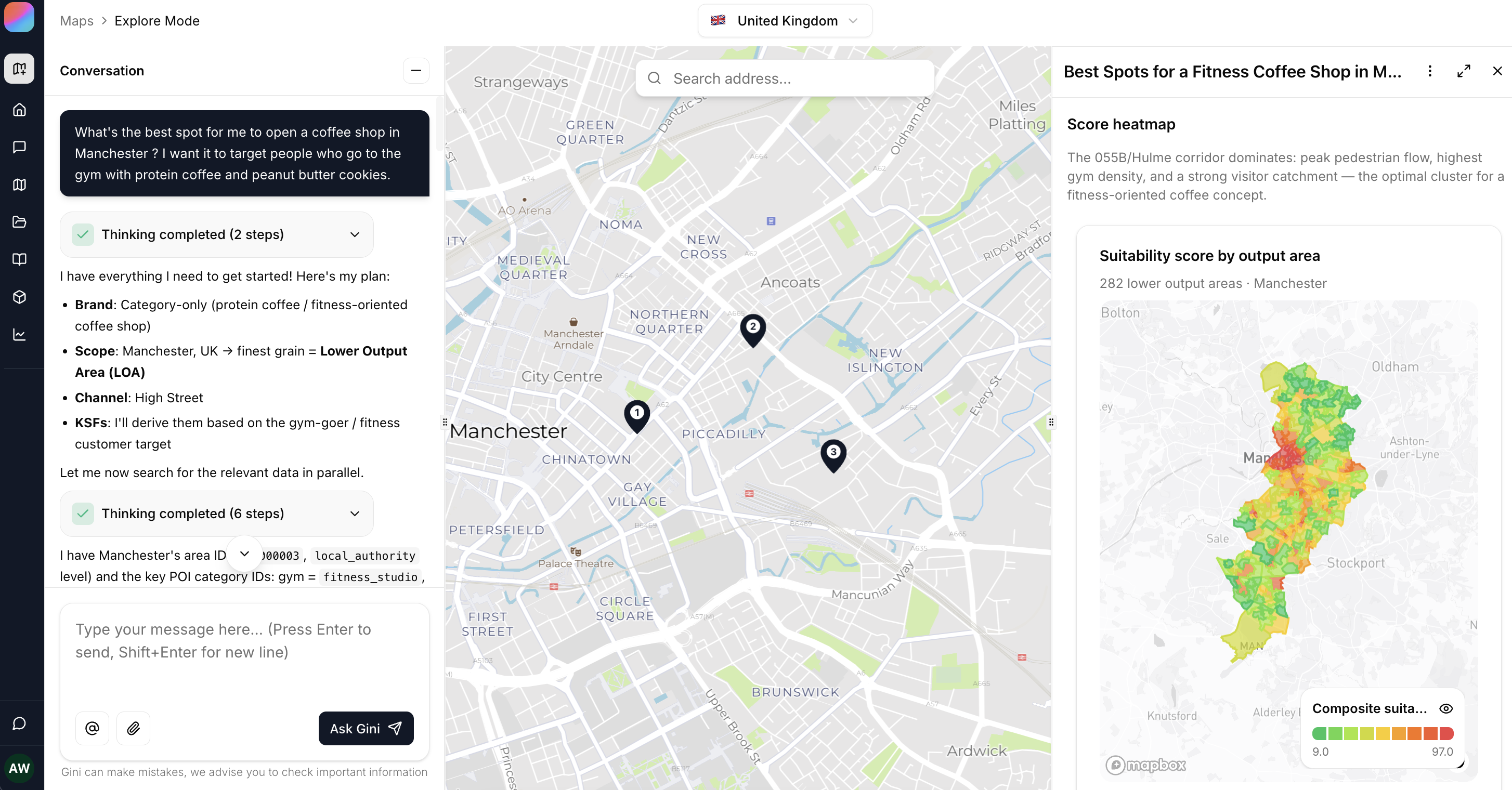
Gini's biggest strength is its unparalleled European coverage, which site selection software designed for the US rarely match, combined with its fantastic US data.
"Thanks to MyTraffic, we get a very precise view of customer traffic, over a week, at a specific time of day. This allows us to make accurate sales forecasts."
Pierre Pico, Director of Development and Construction at Five Guys.
Gini's Pricing:
- Tiny: €249 per month. One seat, five conversations per month, all workflows, all insights, one country of your choice, one export per month. A free trial is available for this.
- Plus: custom pricing. Unlimited conversations, coverage in up to 18 countries, up to unlimited users
2. SiteZeus

SiteZeus built its name on forecasting: it tells you what a location could sell before you commit capital to it. In May 2026 the company announced the Atlas release of SiteZeus Locate. Its release notes describe Ask Zeus conversational AI, automated territory generation, chat-driven reporting, and integrated real-estate listings that let teams evaluate available properties inside the site-selection workflow. SiteZeus says Atlas can generate balanced territories at national scale using a brand's transaction data and other market inputs. White-space analysis projects revenue potential across an entire market, which is what a franchise development team needs when deciding which of twelve open territories to fill first.
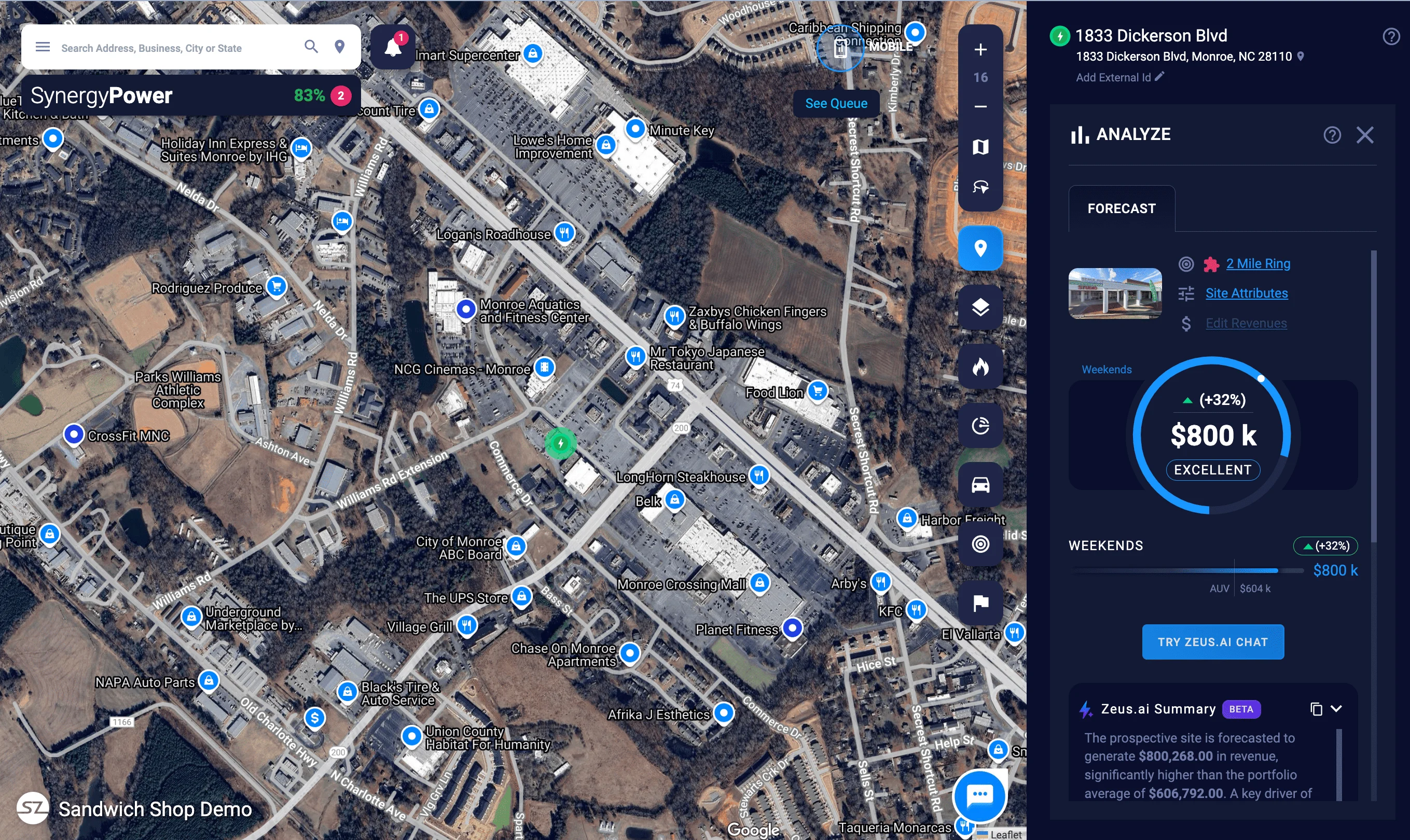
The franchise focus isn't the limitation. That's exactly what SiteZeus is built for.
SiteZeus's publicly described Atlas capabilities are strongly oriented toward US multi-unit and franchise expansion, including national-scale analysis across more than 30,000 US ZIP codes. Teams planning European expansion should confirm country coverage, data sources and model availability directly with SiteZeus. It's also built for teams that expect an implementation process rather than a self-serve sign-up.
"We approach our analytical tools as an investment into making sure that we are minimizing risk, and that we are setting up and making the best decisions possible for new restaurants for long-term success, so we started working with SiteZeus."
Brandon Colby, Regional Director of Real Estate Strategy at Raising Cane's.
SiteZeus's Pricing is on demand.
3. Placer

Placer.ai uses anonymized mobile-location data and statistical modeling to estimate visits, trade areas, visitation trends and competitive performance, according to its platform overview. That coverage extends across a broad range of US locations, subject to coverage, venue definitions and privacy-related reporting thresholds. For validating demand at a candidate site, or measuring how a new competitor opening affects your own traffic, it is among the more established platforms for US visitation intelligence and competitive benchmarking. Placer.ai offers dashboard products as well as data and integration options for customers that need to use location intelligence inside their own systems.
The trade-off is scope. Placer.ai is a foot traffic intelligence platform first, not a full AI site selection engine. It tells you what's happening at a location today; it doesn't run the guided, conversational workflow that turns that data into a ranked shortlist of where to expand next. Its European coverage is also thinner than its US data, which matters if your next ten stores are split across three continents rather than one.
"Placer helped us evaluate a new-build opportunity before construction was completed, something that we couldn't confidently do before we subscribed to Placer."
Ernest DesRochers, SVP and Co-Managing Director, Northmarq.
Placer's Pricing: limited free edition available, full platform on demand.
4. Tango Analytics

Tango's Predictive Analytics offering includes site modeling, trade-area analysis, sales forecasting and candidate-site comparison. Its differentiator is what happens after you open the store. Its product pages list the store-lifecycle activities Tango connects to site selection: lease administration, renewals, occupancy costs and decisions about opening, closing, relocating or consolidating locations. It supports those decisions; it doesn't make them autonomously. If site selection and real estate operations sit in the same team at your company, that integration is a real advantage.
For an organization that wants one integrated real estate platform, that depth is worth paying for. For a smaller team looking only for rapid site screening, it's overkill. The implementation reflects the same split: heavier to deploy than a self-serve tool, with site selection as one module inside a much bigger platform rather than the core product.
"The solution exactly mirrors the way a typical retail real estate process should flow, and directly aligns with processes out-of-the-box, requiring no complicated and expensive customizations."
Tango Analytics' Loblaw Companies Limited case study.
Tango's pricing is on demand.
5. Locata

Locata takes a distinct technical approach. It runs three frontier AI models, Claude, ChatGPT and Gemini, in parallel. Each model scores candidate locations against European public data sources. The output is a ranked shortlist with an explanation of the criteria and data supporting each location's score, according to Locata's own methodology page. Its public positioning is strongest in utilities, EV charging, infrastructure and public-sector use cases, although Locata also describes retail and restaurant applications.
Where Locata has shown the clearest results is candidate screening driven by infrastructure, permitting, cadastral, traffic, parking or grid data. That's a different job from comparing five retail units on footfall and catchment overlap. Retail teams should evaluate Locata through a controlled pilot, particularly when their expansion criteria include infrastructure, parking, permitting or parcel-level constraints. For conventional retail site selection, compare its results against a mobility-led or revenue-forecasting platform before committing.
"Locata delivered our report in three weeks, with per-location reasoning that meant there were no 'the AI said so' conversations. We had a wider funnel and a sharper shortlist."
Statiegeld Nederland
Locata's pricing start's at 2,500$ per month.
How to choose between them
Match the tool to the decision, not the other way around. If you're comparing several European markets and want to work through the analysis in a conversation rather than build it by hand, Gini is designed for business users who want to explore markets and run guided site-selection analyses through natural-language prompts, without constructing every analysis manually in GIS.
A US franchise brand weighing territory planning, white-space analysis and revenue forecasting should have SiteZeus in the evaluation, since that combination is the problem the platform was built around. A team whose main question is how many people visit a site today, and how that compares with the competitor two doors down, should evaluate Placer.ai alongside other mobility-data providers. If site selection is one step in a real estate lifecycle you already manage in a single system, Tango keeps the lease, the renewal and the closure decision in the same place as the opening decision. And when the candidate sites are grid connections or charging points rather than retail units, Locata's multi-model scoring is the closer fit, because infrastructure and public-data constraints sit at the center of that siting decision.
None of these tools replaces a site visit. Mobility and demographic data won't tell you much about frontage visibility, signage, the neighboring tenants or what the walk past the door actually feels like. Access, loading and construction conditions are the same story: you read them on the street, not on a dashboard. At their best, these tools reduce the manual data collection, mapping and first-stage screening that previously consumed much of the early site-selection process.
The bottom line
Run the same five to ten locations you already know well through every product on your shortlist, then compare what comes back against what you already know to be true. The most useful platform is the one whose assumptions your team can inspect, challenge and validate, which is rarely the one that hands you the most confident score.