


.jpeg)

.jpg)
.jpg)

Follow us on
The right shopping centre isn't the biggest one, it's the one where your specific customer already shops. Footfall volume, dwell time, and visitor demographics each tell you something different. Together, they tell you whether to sign the lease.
Aroma-Zone plans to open several new locations in 2026. We ran their three shortlisted shopping centres through a full location analysis (footfall, dwell time, demographic fit, and seasonal risk) to show exactly how that decision gets made with data.
Why does shopping centre selection make or break a retail expansion?
Poor location selection is the most common and most expensive mistake in physical retail. According to the International Council of Shopping Centers (ICSC), specialty retailers who open in locations where their core demographic represents less than 30% of the local visitor base see conversion rates drop by up to 40% compared to well-matched sites. A store that opens in the wrong centre doesn't just underperform. It skews your whole network's data and burns budget that could have funded a better opening elsewhere.
The challenge is that shopping centres are not easy to compare. A centre with 500,000 monthly visitors sounds better than one with 220,000. But if the first centre's visitors are the wrong age, leave within 15 minutes, and drive past three competing stores on the way in, the raw footfall number is misleading.
Aroma-Zone understands this. The brand's core customer, primarily female and skewing 45 and older based on Similarweb web audience data showing the 55–64 bracket as their largest segment, is not evenly distributed across French shopping centres. Finding the right location means finding where she already goes, how long she stays, and whether the centre's overall mix supports the kind of considered, exploratory purchase that DIY cosmetics requires.
That's not a question you can answer by visiting the centres or reading the leasing brochure. It requires location data.
What data do you actually need to evaluate a shopping centre?
To properly evaluate a shopping centre for a specialty retail opening, you need four types of signals. All four, not just one.
Monthly footfall volume tells you the ceiling on your potential customer base. A centre that attracts 125,000 visitors a month gives you a fundamentally smaller pool than one attracting 460,000, regardless of everything else. This is the starting filter, not the deciding one.
Dwell time tells you whether the visit is a quick errand or a browsing session. For a brand like Aroma-Zone, where the in-store experience (touching ingredients, reading labels, asking questions) is the product, dwell time matters enormously. A centre where 80% of visitors stay more than 30 minutes is a centre where people are shopping, not rushing. According to CNCC (Conseil National des Centres Commerciaux) data, average dwell times in French shopping centres vary by up to 25 minutes depending on anchor tenant mix and retail density, a gap wide enough to meaningfully affect conversion.
Visitor demographics tell you whether the footfall is your footfall. Volume and dwell time are irrelevant if the visitor profile doesn't match your customer. For a brand targeting women over 45, a centre where that group represents 51% of visitors is structurally different from one where they represent 41%.
Competitive density tells you whether you're entering a market or fighting for scraps in one. A high-footfall centre with three competing natural beauty concepts already trading is a harder commercial environment than a lower-traffic one where you'd be the clear destination for that category.
How did we compare Bercy 2, Les Belles Feuilles and Nice Lingostière for Aroma-Zone?
Aroma-Zone's expansion strategy targets shopping centres rather than high streets. The reason is straightforward: their core customer is more heavily represented in enclosed retail environments, where the shopping trip is a deliberate social and leisure activity rather than a quick convenience stop. Three centres made their shortlist: Bercy 2 (Paris), Les Belles Feuilles (Paris), and Nice Lingostière (Nice). Here's what the data showed.
Footfall: the gap is larger than expected
Using Gini by Mytraffic data on monthly visitor volumes for 2024:
- Nice Lingostière: ~460,000 visitors/month
- Bercy 2: ~220,000 visitors/month
- Les Belles Feuilles: ~125,000 visitors/month
Nice Lingostière attracts more than twice the footfall of Bercy 2 and nearly four times that of Les Belles Feuilles. On volume alone, it's a different category. But footfall is the starting point, not the conclusion.
Dwell time: who's actually shopping?
The percentage of visitors who stay more than 30 minutes (a proxy for genuine shopping intent rather than a quick pass-through) reveals meaningful differences:
- Nice Lingostière: ~82%
- Bercy 2: ~79%
- Les Belles Feuilles: ~67%
Nice Lingostière and Bercy 2 are close on this metric. Both show that the vast majority of visitors are there to shop, not to cut through. Les Belles Feuilles trails by roughly 12 percentage points — significant when you consider that a lower dwell time means fewer spontaneous discovery visits, and Aroma-Zone's category depends heavily on the customer having the time and inclination to explore.
Demographics: the decisive filter
Aroma-Zone's web audience data from Similarweb shows that the 55–64 age bracket is their single largest online segment, with 45+ visitors collectively making up the majority of their digital audience. That skew toward older female customers is the lens through which the demographic data from each centre becomes decisive.
Percentage of visitors aged 45 and over:
- Nice Lingostière: ~51%
- Les Belles Feuilles: ~45%
- Bercy 2: ~41%
Nice Lingostière doesn't just lead on footfall and dwell time. It leads on the metric that matters most for this specific brand. More than half of its visitors fall within Aroma-Zone's core target age group. Bercy 2, despite its strong volume, has the weakest demographic alignment of the three.
What made Nice Lingostière the strongest candidate, and what is the risk?
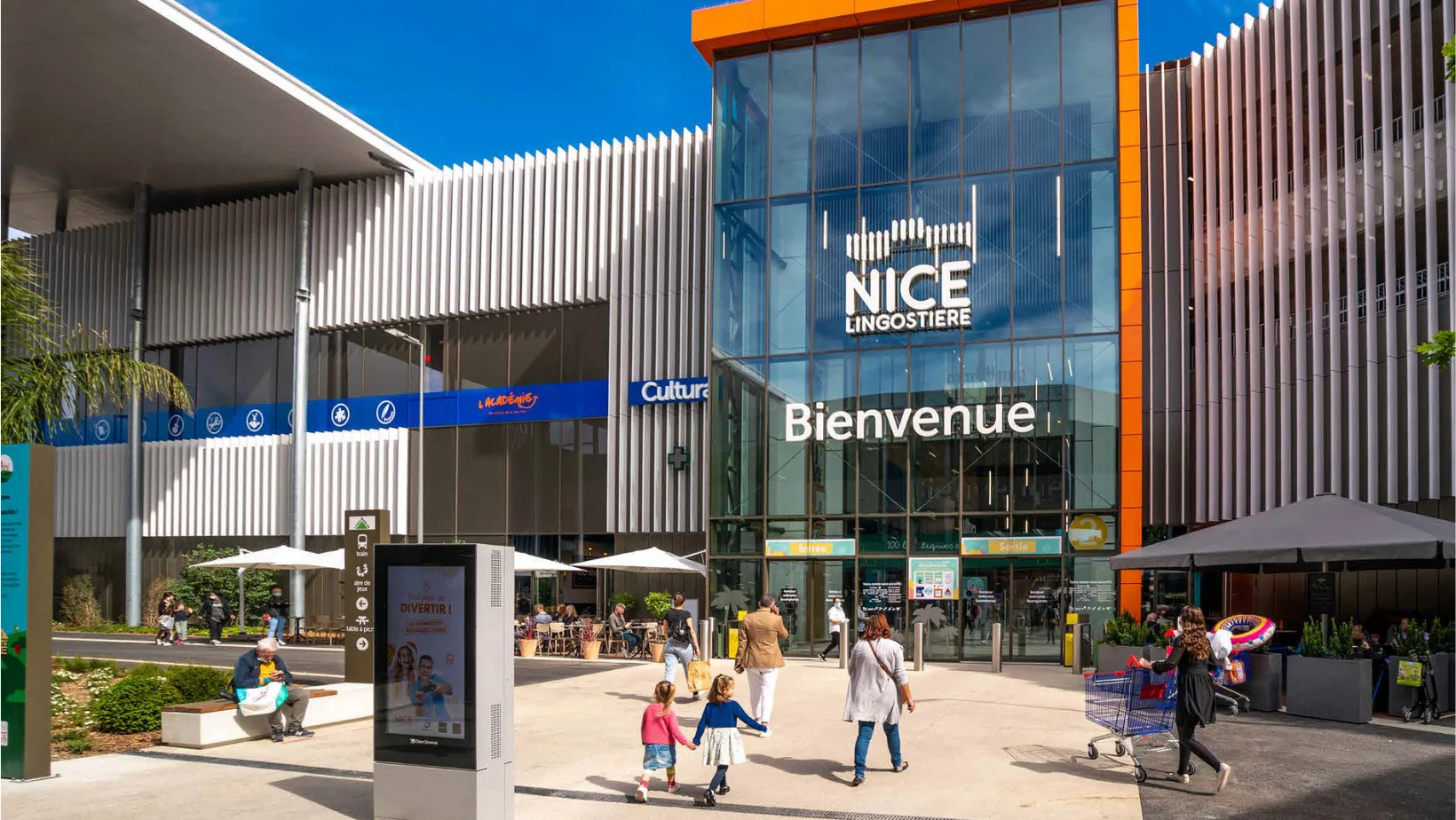
Across all three indicators, Nice Lingostière is the clear recommendation. It attracts the highest volume of visitors, retains them longest, and does so with the highest concentration of Aroma-Zone's core demographic. A brand opening there isn't fighting for visibility in a sea of wrong-fit traffic. It's opening in a location where a majority of visitors are already the target customer.
The risk is real, however, and it deserves a direct answer: Nice Lingostière's footfall is heavily seasonal.
Nice is a tourist city. Its shopping centres see significant peaks in July and August driven by summer visitors, and comparative troughs in January and February. That seasonality does not invalidate the opening — but it changes how you model it. An Aroma-Zone store in Nice Lingostière needs its economics built around a realistic annual average, not peak summer footfall. It also creates an opportunity: the tourist influx may not match the core Aroma-Zone demographic precisely, but it generates trial among new customers who then become online repeat purchasers after returning home.
The right question isn't whether to open in Nice Lingostière. It's how to structure the opening (staffing, stock levels, promotional calendar) to account for a visitor pattern that moves in waves.
How can a brand replicate this analysis across dozens of sites at once?
The Aroma-Zone analysis above covers three centres. Most retail expansion briefs involve 20, 50, or 200 candidate sites. Running this methodology manually, centre by centre and metric by metric, takes weeks and produces results that are already partially outdated by the time the decision is made.
Gini by Mytraffic's Spot Finder workflow connects directly to commercial real estate listings across Europe and filters them by footfall, visitor demographics, traffic patterns, and competitive environment simultaneously. Instead of starting with a shortlist and analysing it, you start with your criteria and let the data build the shortlist.
The Expansion Planner workflow goes a step further. It takes your existing network's performance data (the locations that work, the ones that don't, and the visitor patterns behind the difference) and uses that to identify territories where similar conditions exist. For a brand like Aroma-Zone, that means identifying not just which centres have the right demographic, but which centres have the right demographic and a catchment area where Aroma-Zone is not already cannibalising an existing store.
What previously took a consulting project of several weeks now takes a structured, guided analysis of a few hours. The outputs are ready to share (executive summaries, comparative tables, territorial maps) so the decision can move from data to signature without a translation layer in between.
What are the most common mistakes brands make when choosing shopping centres?
Three mistakes account for the majority of poor expansion decisions in specialty retail.
Chasing footfall without checking demographics. A centre with 600,000 monthly visitors sounds compelling. But if your customer represents 28% of those visitors rather than 51%, your effective addressable footfall is closer to 168,000, less than a smaller centre with better alignment. Volume is the first filter, not the last.
Ignoring dwell time. A centre where visitors stay an average of 18 minutes is structured around convenience retail: supermarkets, pharmacies, click-and-collect. A centre where 80% of visitors stay 30 minutes or more is structured around discovery retail. Those are fundamentally different commercial environments, and specialty brands that open in the wrong type consistently report lower basket sizes and conversion rates, regardless of the footfall number.
Failing to model seasonality before signing. Seasonal variation in footfall is predictable. It shows up clearly in 12 months of location data. But many brands sign leases based on site visits conducted in peak periods, then discover the January reality after the lease is signed. A centre that looks healthy in October can look very different in February, and your rent doesn't adjust with the seasons.
Frequently asked questions
What footfall threshold makes a shopping centre viable for a specialty retailer?
There is no universal threshold. It depends on your conversion rate, average basket size, and rent level. A centre with 150,000 monthly visitors and 48% demographic alignment may outperform one with 400,000 visitors and 30% alignment. The calculation that matters is qualified traffic: total footfall multiplied by the percentage of visitors matching your core customer profile.
How do you assess whether a shopping centre's visitor profile matches your brand?
Location intelligence platforms like Gini by Mytraffic provide visitor demographic data broken down by age, gender, and socioeconomic profile at the individual location level. Cross-referencing this with your own customer data (from CRM, loyalty programmes, or web analytics) gives you a match score for any candidate site.
What is the difference between footfall and qualified traffic?
Footfall is the total number of visitors passing through or entering a location. Qualified traffic filters that number by the percentage who match your target customer profile. A beauty brand targeting women over 45 in a centre where that group represents 51% of visitors has a qualified traffic figure of roughly half the headline footfall. That is the number your commercial model should be built around.
How long does a site analysis typically take with location intelligence tools?
A full site analysis — footfall, dwell time, demographics, competition, catchment area — takes between 30 minutes and a few hours using Gini by Mytraffic's structured workflows, depending on the depth of the output required. Comparing a shortlist of 3 to 5 centres, with a ready-to-share summary, can be completed in a single working session.
Does seasonality always disqualify a high-traffic tourist location?
No. Seasonality is a risk to model, not a reason to rule out a location. The key is building your economics around the annual average rather than the peak, and structuring operations (staffing, stock, promotional calendar) to capture the peak efficiently without being exposed when it ends. For many specialty retail brands, tourist locations generate strong trial with new customers who become online regulars after they leave.
TL;DR
Not all shopping centres are created equal. Footfall volume is where the analysis starts. Demographics are where it ends. And dwell time tells you whether the environment between those two numbers actually supports the kind of shopping your brand depends on.
For Aroma-Zone's 2026 expansion, Nice Lingostière leads on every relevant metric (volume, dwell time, and demographic alignment) with seasonality as the one variable to plan around rather than avoid.
For any brand facing the same question, the methodology is the same: define your customer, find where they already shop, and check whether the environment supports the purchase. Gini by Mytraffic makes that analysis available in hours, not months.
Start a 14-day free trial and run your first site analysis today.