




.jpg)
.jpg)

Follow us on
Most first-time entrepreneurs sign leases the same way. They find a space that feels right, ask around about what other people are paying, and eventually agree to a number that seems "about fair." They have no real idea whether the location can support the rent.
They just hope it works out.
Frédéric Etamé, one of our customers, did it differently. When he found the location for his first ice cream parlour, the asking rent was over €5,000 per month. Instead of guessing, he pulled the foot traffic data for that street, built a rough P&L based on what the location could realistically generate, and walked into the negotiation with a number he could defend. He walked out with a rent of €3,500.
That's not a lucky break. It's a method, and it works for anyone opening their first physical location.
Why landlords quote rents that don't match reality
When a landlord sets an asking rent, they're not thinking about your business model. They're looking at what comparable spaces nearby have recently leased for, and pricing from there.
That means the number you're given reflects the market, not the location's actual revenue potential for your specific concept. A street with decent foot traffic might command €4,000 per month because a pharmacy chain just signed a deal there. That doesn't mean an ice cream parlour, a yoga studio, or a pet supplies shop can support the same rent.
Most tenants don't push back because they don't have an alternative argument. They can say "that feels expensive," but they can't say why — and feelings don't move landlords.
Data does. Understanding how foot traffic data helps you choose the right location is already half the negotiation. The other half is turning that data into a P&L the landlord has to reckon with.
According to Coldwell Banker Commercial Capital Advisors, retailers should target rent no higher than 5% to 10% of gross annual sales, with 6% to 8% being the healthy range for retail and QSR operators. Most landlords know this benchmark. Most first-time tenants don't.
The formula Frédéric used (and you can too)
Frédéric's approach had four steps. You can watch him walk through the full process in this first video and this second one. Here's how the method works.
Step 1: Pull the real foot traffic numbers
The first question is simple: how many people actually walk past this location?
Not how many live nearby, not how many pass through the broader neighbourhood. The specific street, in front of the specific door, broken down by hour and day.
Foot traffic data tools give you this. You can see total weekly footfall, peak hours, the days that drive most of the traffic, and how those patterns compare to the surrounding area. For Frédéric's location, this step also told him something just as important: who those people were. Age range, spending behaviour, whether they were local regulars or passing through.
That matters because not every person who walks past is a potential customer.
Step 2: Filter for your addressable market
Total footfall is not your market. It's the raw number. Your market is the share of that footfall that could realistically stop and buy from you.
Frédéric was opening an ice cream parlour. His addressable visitors were people who matched the profile: families with children, young adults on weekend afternoons, tourists in summer. He cross-referenced the demographic breakdown from the footfall data against that profile and arrived at a percentage — his realistic conversion pool.
The formula looks like this:
Addressable footfall = Total footfall × % of relevant visitor profiles
If 10,000 people pass per week and 30% match your target customer profile, your addressable footfall is 3,000 people.
Step 3: Build a rough P&L from the data
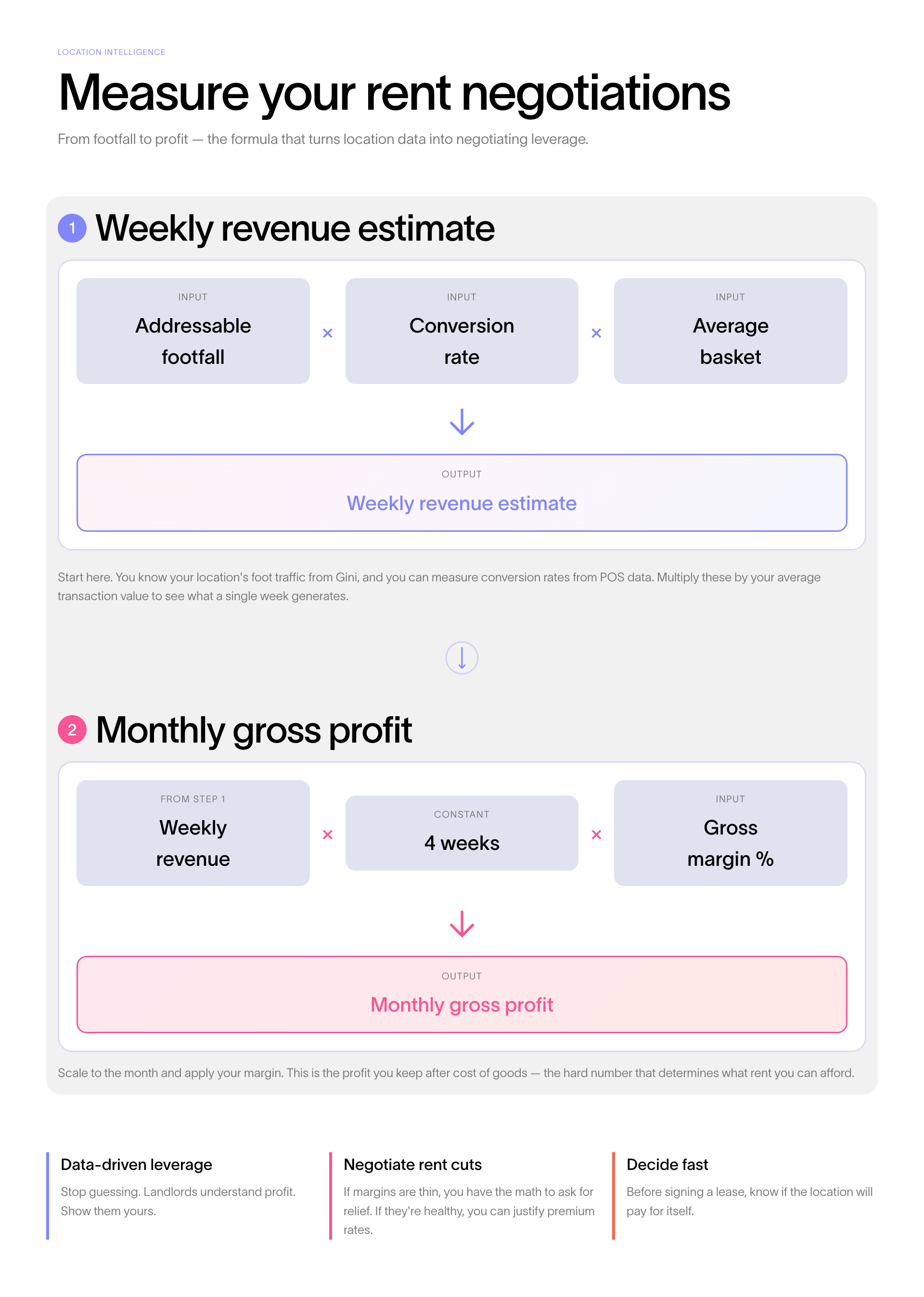
Once you have an addressable footfall figure, you can estimate revenue. You need three industry benchmarks for your specific sector:
- Average conversion rate (street-to-customer): what percentage of people passing a similar type of shop actually come in and purchase something
- Average basket value: how much a customer typically spends per visit
- Average gross margin: what percentage of that revenue you keep after cost of goods
These figures are available by sector from industry associations, food service bodies, and franchise disclosure documents. For an ice cream parlour in France, Frédéric used established food and beverage benchmarks.
The calculation:
Weekly revenue estimate = Addressable footfall × Conversion rate × Average basket
Monthly gross profit = Weekly revenue estimate × 4 × Gross margin
With those numbers in hand, you have a realistic ceiling for what the location can generate. And rent, by industry convention, should not exceed a defined share of that gross revenue. For F&B operators, The Fork CPAs recommend targeting no more than 8% occupancy cost as a percentage of sales, with 5% to 7% being the ideal range.
Step 4: Calculate what rent can reasonably be
With a monthly gross profit estimate, you work backwards:
Maximum sustainable rent = Monthly gross profit × Maximum rent-to-revenue ratio
For Frédéric, this calculation put the supportable rent at around €3,500 per month. The landlord was asking for €5,000+. The gap between those two numbers was no longer a feeling. It was a documented mismatch between asking rent and realistic business potential.
What to say to the landlord
The conversation Frédéric had was not confrontational. He didn't tell the landlord the price was wrong. He showed the landlord what the location could support.
The framing matters. You are not saying "your rent is too high." You are saying "here is the revenue this location can realistically generate for a business like mine, and here is the rent that leaves enough margin to build a viable operation." That's a business conversation, not a complaint.
Landlords care about one thing: a tenant who stays. A tenant paying rent they can't sustain is a landlord problem waiting to happen. As PassBy's foot traffic guide puts it, traffic data provides objective evidence for rent discussions — when a location's numbers don't support the asking price, that data point changes the conversation. When you walk in with a P&L grounded in real footfall figures, you're offering the landlord a credible picture of your ability to remain a reliable tenant.
Frédéric's opening was essentially: "Here's what this location can generate, here's what rent I can sustain within industry norms, and here's how I arrived at both numbers." The landlord didn't agree immediately. But the conversation shifted from a price debate to a numbers discussion — and numbers are a much better place to be.
The final outcome: rent down from over €5,000 to €3,500. That's a difference of €18,000 per year, before the business had served a single customer.
What this doesn't cover, and when to be careful
This method is powerful, but it is an estimate. A few honest caveats before you go into a negotiation.
Conversion rates are averages. The industry benchmarks you use are based on existing businesses. Your first-year conversion rate may be lower while you build awareness. Build that into your model rather than assuming best-case performance from day one.
Seasonality matters more than monthly averages. An ice cream parlour in Paris has a very different August than it does in January. If your concept is seasonal, look at the monthly footfall breakdown rather than annual averages, and base your rent capacity on off-peak months, not peak ones.
Not all footfall is equal. High foot traffic from commuters rushing to a metro station is different from high foot traffic from people browsing a shopping street. Check dwell time data alongside volume. A location where people stop and linger is a different asset than one where they walk through fast.
For a deeper look at how location data works beyond rent negotiation, the methodology for selecting a flagship store location covers how professionals score locations before committing.
Run the numbers before you sign
Frédéric's result was not exceptional. It was what happens when you replace gut feel with data and walk into a negotiation with a documented argument.
The foot traffic data was available to anyone. The formula was based on public benchmarks. The method is repeatable.
What most first-time entrepreneurs lack is not the information. It's the habit of pulling it together before the conversation starts.
Gini by MyTraffic gives you the footfall numbers, the demographic breakdown, and the location context you need to run this analysis before you sign anything. You can model the addressable market, benchmark the location, and go into your landlord meeting with a P&L that holds up.
Use Gini by MyTraffic to negotiate with real data.
TL;DR
Before signing any lease, you can use foot traffic data to model your location's real revenue potential, then show the landlord exactly why the rent should be lower — with numbers they can't argue with.