

%20(1).jpg)
.jpeg)
.jpeg)
.jpg)
.jpg)

Follow us on
How to evaluate a retail location before signing a lease
Six checks, in this order: footfall at the door, the real trade area, the demographics inside it, the competitive set, accessibility, and the lease clauses themselves. Any one of them can rule out a site. Run them before you negotiate, not after.
You evaluate a retail location before signing a lease because the lease is the least reversible decision a first-time operator makes. Staff, pricing, opening hours, product mix: all of that can change in a week. Square footage on a nine-year term cannot. And the odds are tighter than most people assume. Of US establishments born in 2022, between 74.4% and 78.6% survived their first year depending on the region, according to Bureau of Labor Statistics data on establishment survival by census division. Roughly one in four did not reach twelve months.
Location doesn't explain all of that, it does however set the baseline on everything else. For example, not enough traffic and even the best business on earth would fail.
The order below is deliberate. The cheap checks come first, so you disqualify weak sites before you spend money on a lawyer or a surveyor.
1. Count the footfall passing the door
Start with how many people physically walk past the address, broken down by hour and by day of the week. That number is the raw material for every revenue estimate you make later.
Two things matter more than the weekly total. The first is the shape of the day: a site with 40,000 weekly passers-by that peaks at 8am suits a bakery and starves a wine bar. Match the peaks to the hours you intend to trade.
The second is stability, so look at twelve months rather than one. A street that lives off a summer market or a single office tower has a footfall profile that collapses for part of the year. Your rent does not, and should therefore be accounted for.
Two sites on the same street can differ by 30% or more in passing traffic because of a corner, a crossing, or a bus stop. So measure the address, not the neighbourhood. Mobility data platforms, Gini by MyTraffic among them, report hourly footfall per address rather than per postcode, which is the level of detail this decision needs.
2. Map the real trade area, not a circle on a map
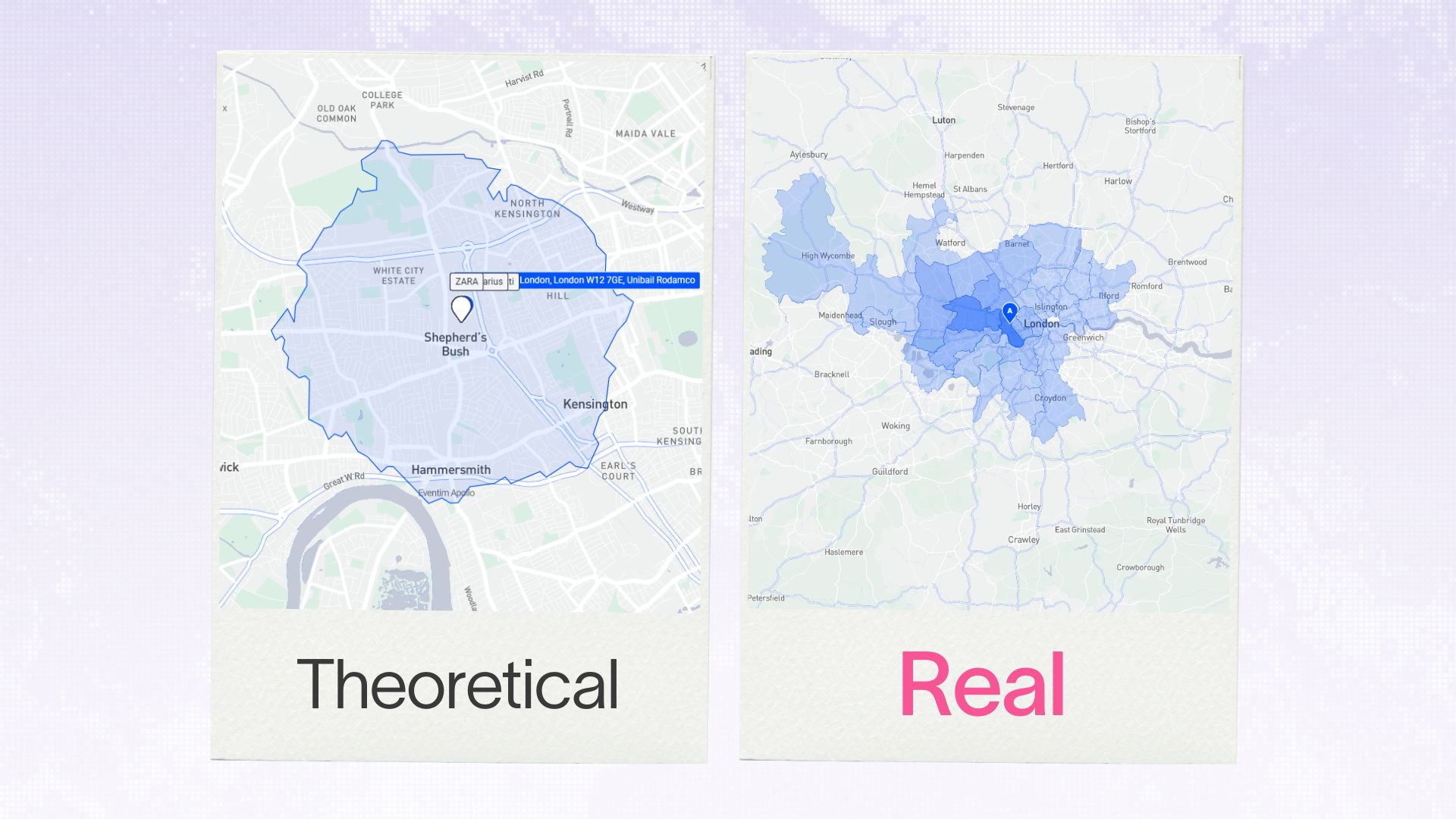
Your trade area is where your customers actually come from, and it is almost never a neat radius. It follows roads, transit lines, and habits, and it stops dead at a river, a motorway, or a rival cluster.
The boundary you draw decides the population count behind your forecast. A 10-minute drive-time zone and a 1km circle around the same site can differ by a factor of three. Draw it wrong and every number downstream is wrong with it.
Use travel time rather than distance. Certain tools even let you map out your real catchment area by measuring where visitors come from. Nevertheless, working out your real catchment area is primordial, as it lets you see what your real addressable market is, who lives in it, and where to target your future marketing campaigns.
3. Check whether the people in the trade area are your customers
Volume without fit is a trap. Once the trade area is drawn, compare the people inside it against the customer you are actually building for.
Look at four things: age structure, household income, household type, and daytime versus resident population. A concept built around families with cars needs a different profile from one built around students or office workers on a 40-minute lunch break.
Write the profile down before you look at the data, otherwise you will talk yourself into whatever the site happens to show. If your average spend only works above a certain household income band, put a number on it, then check what share of the trade area clears it.
Here is what that looks like in practice. Say you are opening a 40-cover neighbourhood bistro with a €35 average spend, open for lunch and dinner. Your written profile might be: households above €45,000 income making up at least 30% of the trade area, a resident population of 15,000 or more within a 10-minute walk, and enough daytime workers nearby to fill lunch service on a Tuesday. Now you have three pass-or-fail numbers. Site A has the income and the residents but empties at 6pm, so dinner service carries the whole week. Site B has half the residents and a large office block across the road, so lunch is strong and dinner is thin. Neither is disqualified, but you now know which service you are betting the lease on, and you can price and staff accordingly.
If you already run one location, use its customer profile as the benchmark and score candidates against it. Identifying the success factors behind your existing stores turns a subjective judgement into a comparison.
4. Study the competition, and the neighbours who help you
Map every direct competitor within the trade area, then map the businesses that pull the same customer without competing for the same wallet.
The instinct is to treat nearby competitors as a reason to walk away. Often they are the opposite. Clusters exist because they work: a street with four coffee shops has more coffee traffic than a street with none, and a large anchor tenant pulls footfall that smaller neighbours convert.
What should worry you is a competitor with the same offer at the same price point in a better position on the same street. Worry too about a site with no complementary businesses at all, because you will be paying to generate every visit yourself. And if you already run a location nearby, check the overlap: two of your own sites drawing from the same 10-minute zone move sales between them rather than add.
5. Test accessibility and visibility the way a customer would
Walk the approach from every direction a customer will arrive from, then note what makes them stop or give up.
The list is short and physical. Can they see the frontage from far enough away to react? Is the nearest crossing at the door or 200 metres down the road? Where do people actually park, and what does it cost them? Is there step-free access, and can a delivery vehicle reach the back without blocking the pavement? Frontage and sightlines carry more weight than most first-time tenants expect.
Then check what is planned. Roadworks, a new transit line, a pedestrianisation scheme, or the redevelopment of the block opposite will all reshape footfall inside your lease term. Local planning portals list applications publicly, and searching them takes an afternoon.
Do the site visit at least three times: a weekday morning, a weekday evening, and a Saturday. The point is to confirm or contradict what the data told you. When the two disagree, go back and find out why before you assume either one is wrong.
6. Read the lease for the clauses that outlive your business plan
Before you commit, confirm the site is legally usable for your business and that the terms let you leave.
Zoning and permitted use come first. Confirm the property conforms to local zoning for your activity and that you can obtain the licences you need at that address, because as the SBA guidance on licences and permits notes, requirements depend on both your business activity and your location. For food service, add extraction, waste, and late-hours consent to the list. Get written confirmation from the local licensing office rather than the landlord's assurance.
Then read for five things: how narrow the permitted use clause is, whether service charges are capped and what the last two years actually cost, whether a personal guarantee is required and when it falls away, what happens if you need to exit early, and whether you can assign or sublet if you sell the business.
A narrow use clause is the quiet one. If it names your exact concept, you cannot pivot, and you cannot sell the lease to anyone who would.
Bring your footfall evidence into the negotiation itself. A landlord asking premium rent for a premium position is easier to argue with when you can show what the position actually delivers, which is the practical use of foot traffic data in a lease negotiation.
7. Run the break-even before you sign anything
Build the simplest possible model: realistic transactions per day, realistic average spend, gross margin, then total occupancy cost. If the site only works at your optimistic case, it does not work.
Use occupancy cost as a percentage of expected sales as your sanity check, and remember the healthy range depends on your margins. As the Adventures in CRE definition of occupancy cost percentage sets out, a grocery tenant sits around 2% to 3% while an apparel tenant can carry 12% to 15%, because the products carry different margins. Work out your own ceiling from your gross margin, then check what this rent implies at your forecast sales.
Count everything, not just base rent: service charges, business rates, insurance, fit-out amortised over the term, and the rent-free period you did or did not get. Then stress it. What does the model look like at 70% of your forecast conversion? That number tells you whether you survive a slow first year.
Frequently asked questions
How much footfall does a retail location need?
There is no universal figure, because conversion rate varies enormously by category. Work backwards instead: divide your required daily transactions by a realistic capture rate for your sector, and that gives the passing footfall you need. Then compare it against what the site actually delivers.
What is the difference between footfall and a trade area?
Footfall is the number of people passing a specific address. A trade area is the geographic zone your customers travel from. Footfall tells you about impulse and passing trade. Trade area tells you about the addressable market for planned visits.
Should I choose high footfall or lower rent?
Neither in isolation. Compare occupancy cost as a percentage of the sales each site can realistically produce. A high-footfall site at 18% occupancy cost is usually worse than a quieter site at 8%, unless your margins are unusually high.
How long should I study a site before signing?
Long enough to see twelve months of footfall data and to visit in person on at least three different days and dayparts. Data plus three visits typically takes two weeks, against a lease you will hold for years.
Can I evaluate a location without paying for data?
Partly. Census data, local planning portals, and manual footfall counts are free and will disqualify obviously weak sites. What they will not give you is hourly footfall per address or the ability to compare several candidates on the same basis, which is where the decision usually gets made.
TL;DR
Run these seven checks on every shortlisted address, in the same order, and record the answers side by side. The comparison produces the decision, not any single site's numbers in isolation.
Your advantage right now is that nothing is signed. A data-backed no costs you two weeks. A bad lease costs you the business. Before you commit, put your shortlist through the wider data-driven checklist for choosing a location, then compare the sites on footfall, trade area, and demographics side by side.