

.jpg)
.jpeg)
.jpg)
.jpg)

Follow us on
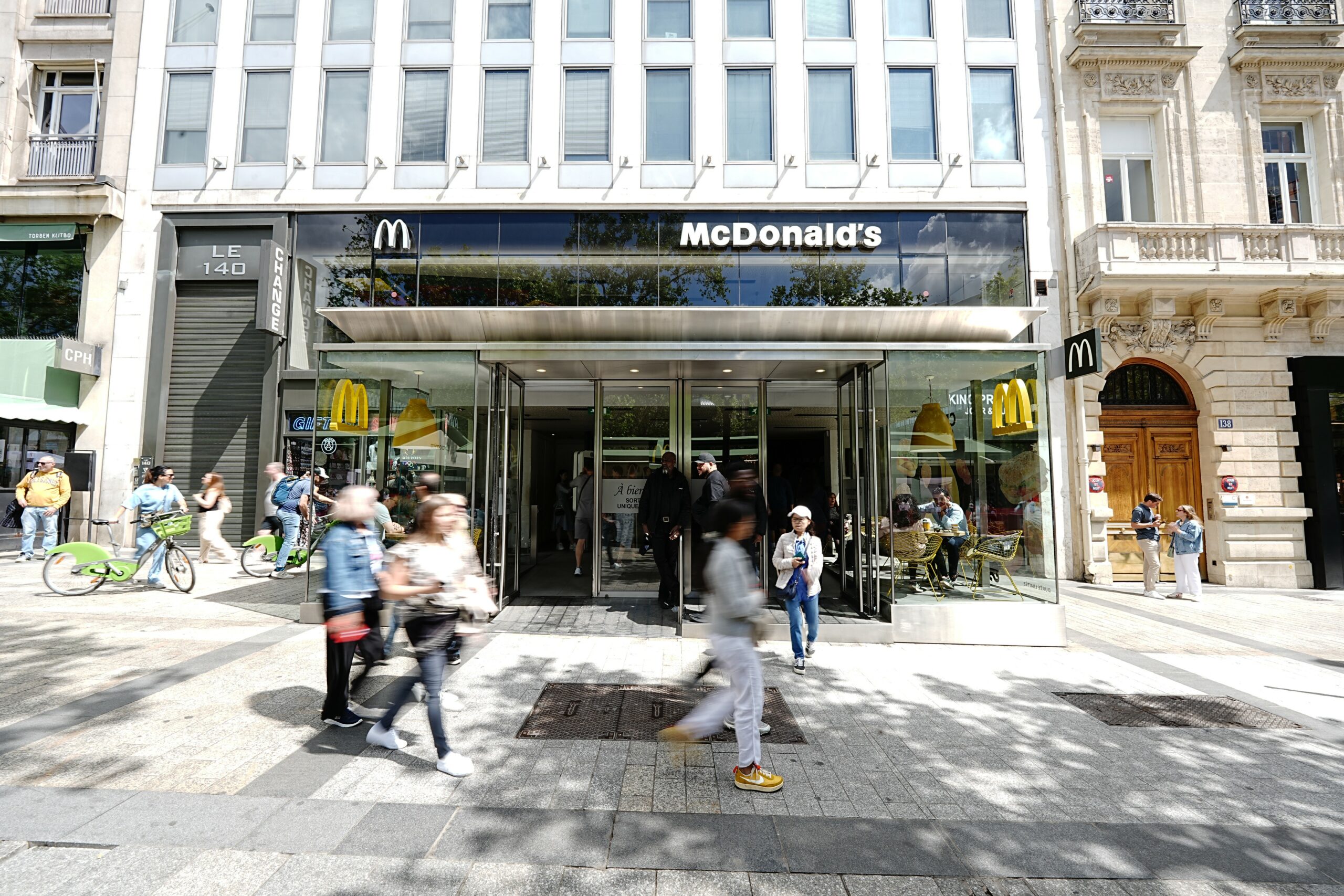
A new restaurant opened three blocks away, and your dining room has felt emptier ever since. Luckily, that feeling is not proof. Before you touch your menu, your prices, or your marketing budget, you need to know whether that opening actually moved your numbers, or whether something else is quietly doing the damage.
Restaurants can't afford to guess wrong. Margins are already thin: 42% of restaurant operators said their business was not profitable in 2025, up from 29% the year before, and 33% reported same-store sales down this spring, according to the National Restaurant Association's economic indicators. In that environment, spending money to fix the wrong problem is expensive. Here's how to find the right one.
Start with your own point-of-sale (POS) data
Your point-of-sale system is the fastest place to look, and it's also the most misleading if you stop there. Pull daily and weekly sales for the four to eight weeks before and after your competitors opening. Compare that window to the same period last year, not just last month, so a normal seasonal dip doesn't get blamed on the new place down the street.
What you're looking for is a sudden, sustained drop that starts right around the competitor's opening date, not a slow fade that had already begun beforehand. A slow fade usually points somewhere else: a menu that needs refreshing, service that's slipped, a bad Google Maps review, or a local event calendar that's changed. A sharp break tied to a specific date is a much stronger signal, but your POS data can only tell you sales went down. It can't tell you why. For that, you need to look outside the till.
Check if it's traffic or conversion
This is the step most restaurant owners skip, and it's the one that actually tells you what's happening. Sales and foot traffic are two different numbers, and confusing them leads to the wrong fix. Foot traffic (how many people pass by or enter your street) and capture rate (the share of those passersby who actually walk in) both require data your POS system doesn't collect. A location intelligence platform, a door counter, or your Google Business Profile insights can fill that gap; more on how below.
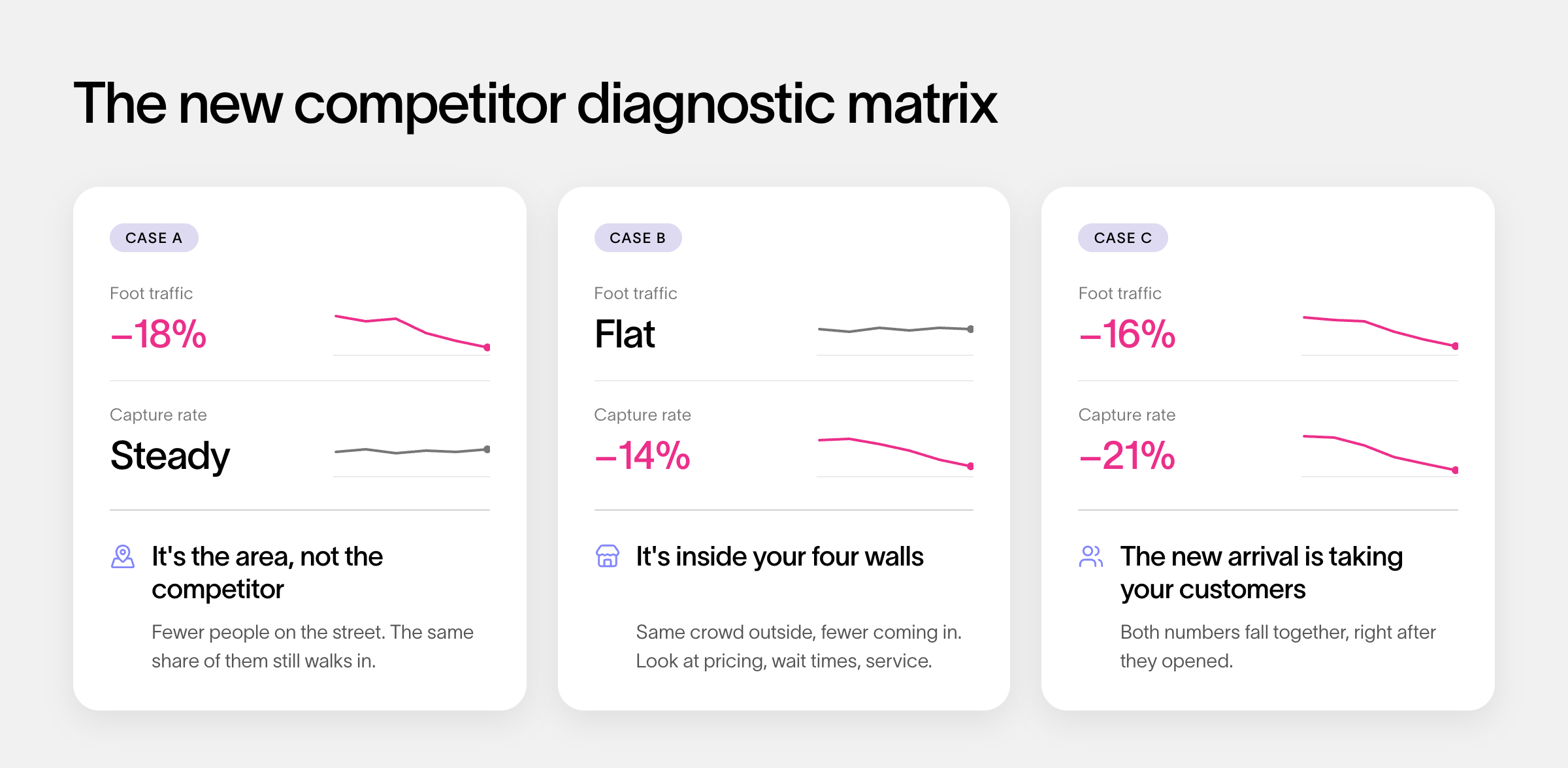
Once you have that traffic figure, the logic is straightforward. If foot traffic near your restaurant is down but your capture rate has held steady, the problem probably isn't the new competitor. It's that fewer people are in the area at all. If traffic is flat but sales have dropped, something changed inside your four walls: pricing, wait times, or a service issue. But if both traffic and sales drop at once, right after the opening, that's a strong signal the new arrival is pulling people who used to walk into your restaurant instead.
A new competitor isn't automatically bad news for that traffic number, either. An academic study on grocery store openings, found the same pattern: nearby businesses within a tenth of a mile saw foot traffic rise by 23.4% within six to twelve months of the new opening, with the effect fading sharply beyond that radius. The study covers grocery, not restaurants specifically, but the mechanism, a new draw pulling more people into the area overall, applies just as well to a restaurant row. Sometimes a competitor moving in next door is free marketing for the whole block.
Look at how visitor profiles changed
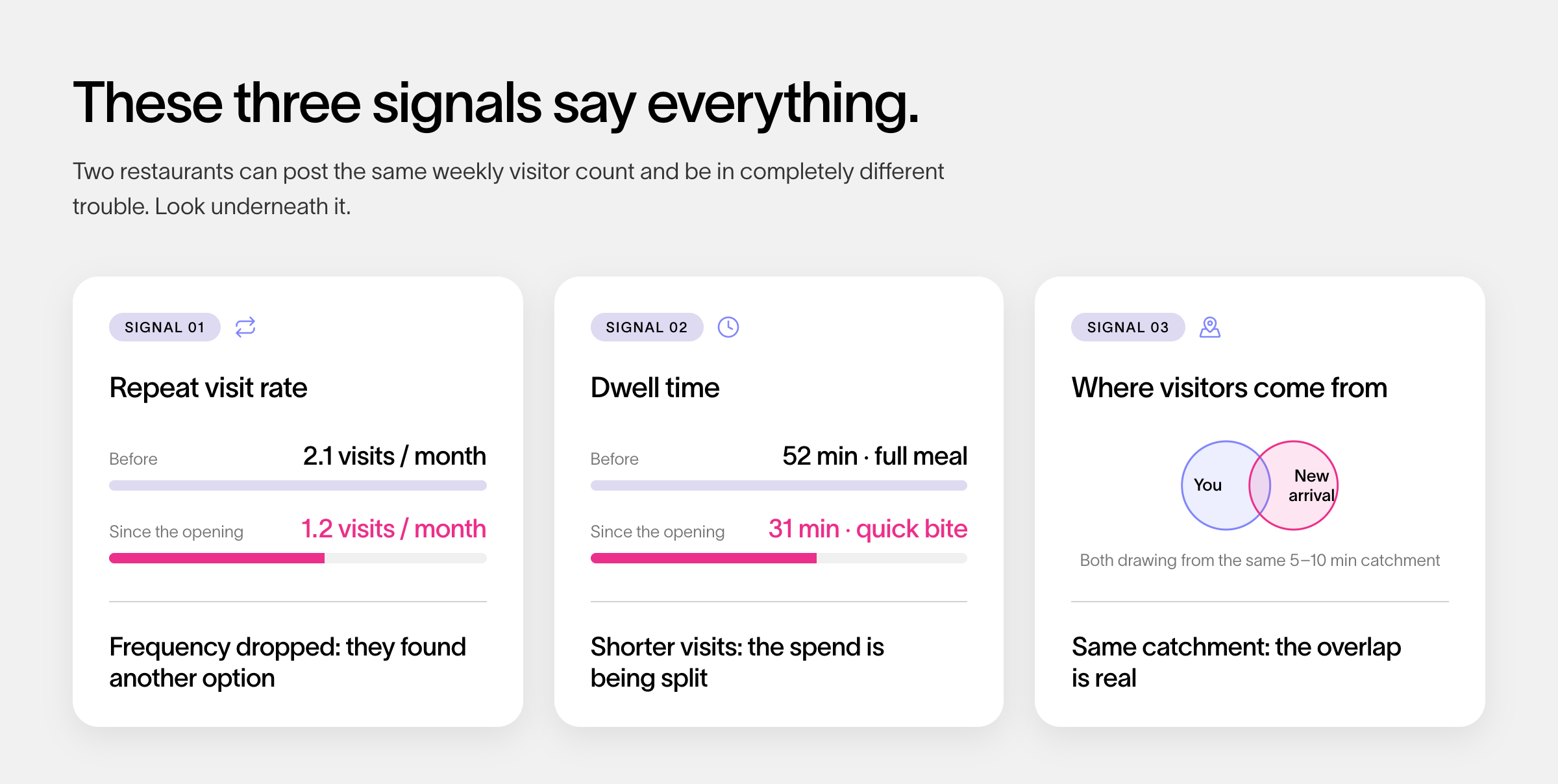
Totals hide a lot. Two restaurants can show the same weekly visitor count and tell completely different stories underneath it, so look past the headline number. This is where visitor profile data, again something a location intelligence platform like Gini by MyTraffic tracks rather than your POS system, earns its keep.
Check your repeat visit rate first. If your regulars are still visiting about as often as before, say twice a month rather than once, you haven't lost your core base, whatever the topline number says. If that frequency has dropped, that's the clearest sign a new option has pulled them away. Next, look at dwell time: a drop can mean people are now splitting their spend between your restaurant and the new one, showing up for a quick bite where they used to linger over a full meal. Finally, check where your visitors come from. If the new competitor draws from the same five to ten minute radius as you, an overlap is far more likely to be real than if it's pulling from a completely different catchment.
Separate a real hit from normal fluctuation
Foot traffic and sales move around every week for reasons that have nothing to do with competition: weather, roadworks, a local festival, even a shift in your own staffing. Before you conclude a competitor is the cause, you need a baseline to measure against, and a real number for what counts as normal.
Set your average weekly traffic and sales for the weeks before the opening, then build in a variance range around that average. If your typical week runs 800 visits, for example, a range of roughly plus or minus 10%, so 720 to 880, is a reasonable band for normal week-to-week noise. Only treat a drop as a real impact if it breaks outside that range and holds for several weeks in a row, not just one bad Tuesday. Then rule out the obvious alternatives: was there construction on your street, a change in local events, or a shift in your own hours or staffing during the same window? A drop that survives that filter is one you can act on with confidence.
For a rule of thumb on how big that drop needs to be before it's worth acting on, location intelligence providers that track store-to-store cannibalization often treat a sustained traffic decline above 20% at an existing location, tied directly to a nearby opening, as a meaningful signal rather than noise. The same threshold that a retail chain uses to judge whether a new store down the road is cutting into an existing one applies just as well when the "new store" belongs to a competitor rather than your own network.
What to do once you've confirmed the impact
Once the data holds up, don't panic and don't guess at the fix. Match your response to what the numbers actually showed you.
If it's a traffic problem, fewer people walking by at all, your best move is usually visibility: signage, local search presence, or a push to get back on people's radar in the area. If it's a capture problem, traffic held steady but people are choosing the other place, look at what's making the competitor's storefront or offer more appealing in that exact moment: wait times, curb appeal, or a promotional push tied to their opening. If your regulars specifically went quiet, a direct win-back offer aimed at loyalty members tends to work faster than a general discount aimed at everyone.
This is also the point where ongoing monitoring pays for itself. A one-time check tells you what already happened. Continuous foot traffic and catchment tracking tells you the moment it starts happening again, whether that's this competitor adjusting their approach or the next one moving in down the block. The marketing team behind Leroy Merlin's shift toward precision targeting found that this kind of ongoing visibility changed how quickly they reacted to shifts in visitor behavior and catchement area analysis, a discipline that scales down to a single restaurant just as well as it scales up to a national retail network.
The bottom line
Gut feeling isn't proof, but the data to confirm or rule out a competitor's impact isn't hard to get. Start with your POS numbers, separate traffic from capture rate, watch how your visitor profiles shift, and hold every drop against a real baseline before you act on it. As our Primark effect research shows, a new arrival next door can grow the whole area's traffic instead of just splitting it, so don't assume the worst before the numbers confirm it either way. Once you know what actually happened, the next move is obvious instead of a guess.
If you want to stop running this check manually every time a new sign goes up nearby, Gini by MyTraffic tracks foot traffic, visitor profiles, and catchment overlap continuously, so you see the shift the week it happens rather than months later.
TL;DR
Compare your POS data, foot traffic, capture rate, and visitor profiles from before and after the opening. If sales and traffic both drop right when the doors opened next door, and the drop holds beyond a normal weekly variance range, you have your answer.