




Follow us on
Opening a cannabis dispensary that still makes money in 2026 starts with an uncomfortable fact: the product is a commodity, prices have collapsed, and many of the venture-backed chains operating across several states (multi-state operators, or MSOs) that were meant to dominate the category are losing money. The independents still making money got their pre-opening decisions right, and this guide runs through those checks in order. California and Los Angeles carry the examples, because California is the largest and most competitive legal market in the US. If you're opening somewhere else, the section before Step 1 shows where to find your own state's version of each rule.
This is not legal advice: the rules below were checked in October 2026 and change often, so verify current state and local rules with the regulator and a licensed attorney before you act.
Why the market you're entering looks nothing like the pitch decks
Most of the figures in this section come from Modern MBA's case study Why marijuana legalization never paid off (2025), which follows three Los Angeles independents, Mecca, ERBA and HERB, through the downturn. Their numbers are owner disclosures rather than audited accounts, but they're among the few store-level figures published on the sector.

California sold about $5.1 billion of legal cannabis in 2023, while roughly $8 billion moved through the illicit market. For every dollar spent in a licensed store, about $1.60 went to unlicensed sellers, and those sellers are part of your competition. Wholesale prices roughly halved between 2020 and 2024, dragging shelf prices down with them, and between 2020 and 2025 nearly four in ten California dispensaries shut down.
The MSOs bet on scale and branding, and neither protected them once prices fell: MedMen went from a $3 billion valuation to bankruptcy in six years. The independents that survived run small and watch every line of their profit and loss statement.
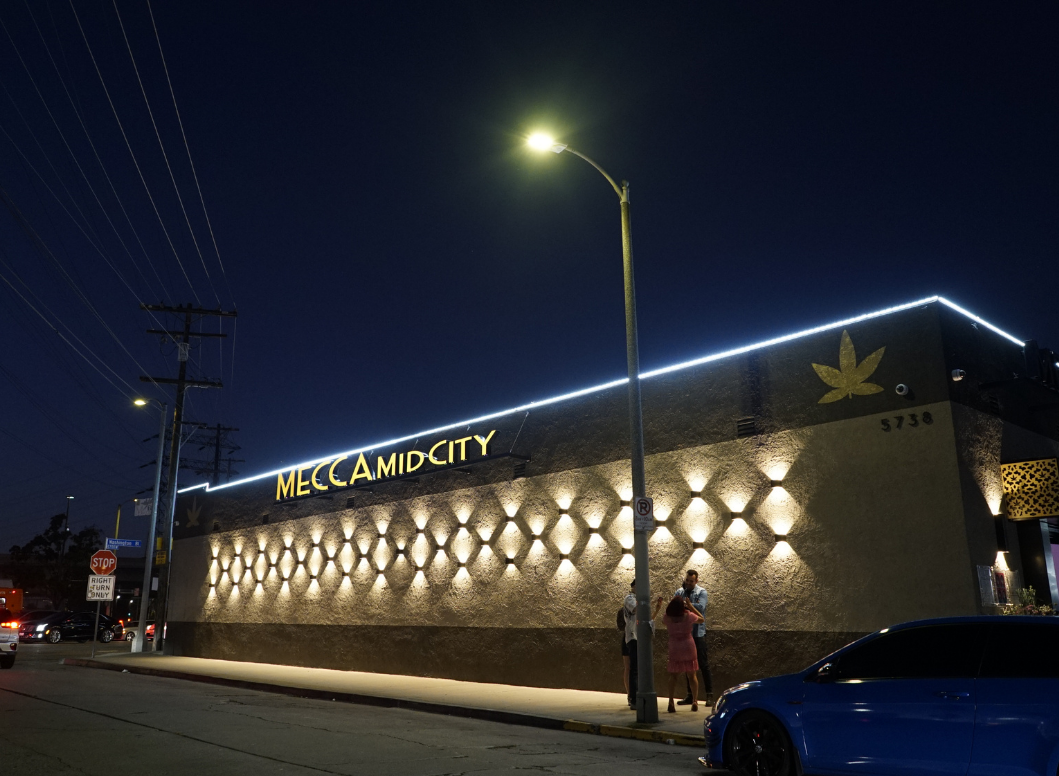
Mecca, a single Los Angeles storefront, reports about $8 million in annual sales at a 25% operating margin, or roughly $2 million of profit. ERBA makes about $4 million from $35 million of sales, but across four stores. One well-run store earns half as much as ERBA's four combined.
If you're not in California: where to find your state's rules
Roughly half the states, plus Washington, D.C., now allow adult-use (recreational) cannabis sales. Most of the rest run medical-only programs, and about a dozen allow neither. If your state is in the last group, there's no license to apply for yet.
The seven steps below work the same way everywhere. Only the numbers change, and here's where to find yours:
- License rules: your state's cannabis regulator (every legal state has one, though it may be called a commission, board or department), plus your city or county's licensing office.
- Buffer distances: state cannabis law sets a minimum, and city or county zoning codes often add to it. Search your municipal code for "cannabis" or "marijuana."
- Taxes: your state revenue department for cannabis and sales taxes, and your city's finance office for any local cannabis tax.
The federal rules in Steps 5 and 6, on tax and banking, apply the same way in every state.
Step 1: Confirm a license path exists at both state and city level
The first question most new operators need to have an answer for is whether a storefront can legally exist in the city they have in mind. State legalization doesn't mean local permission. In California, a retailer needs a state license from the Department of Cannabis Control (DCC) and a local authorization, and the local one is the harder of the two, because most of the state bans retail outright.
The DCC's own data, updated February 2026, shows that 302 of California's 540 cities and counties (56%) don't allow any retail cannabis business, so for more than half the state the answer to Step 1 is already no. California isn't unusual. A Cannabis Business Times analysis from April 2024 found that an average of 47% of local governments in adult-use states prohibited retail sales, with Maine at 83% and Michigan at 74%. Wherever you are, expect up to half the towns in your state to be off the table before you look at a single property.
In the City of Los Angeles, the Department of Cannabis Regulation handles licensing. New storefront licenses in the city have gone through its Social Equity Program, which reserves licenses for people harmed by past cannabis enforcement. Applicants qualify through low income, a past California cannabis arrest or conviction, or living in a part of the city that was heavily policed for cannabis. Check on DCR's site whether you qualify and whether an application window is open. If you don't qualify, your realistic routes are partnering with an eligible applicant or buying into an existing licensed business, if the city allows the ownership change.
Licensing also takes time, and many cities expect you to have a property secured when you apply, so budget for rent while you wait for approval.
If a target city bans storefronts, caps licenses you can't get or has no open window, drop it, however busy its streets look.
Step 2: Map the buffer zones before you look at a single property
This is where dispensary site selection becomes a mapping problem. Every legal market sets minimum distances between a dispensary and "sensitive uses," meaning places like schools, parks and day care centers that the law protects. Draw those circles on a map and they overlap until little of a commercial corridor is left.
At state level, California's Business and Professions Code section 26054 puts licensed premises outside a 600-foot radius of any K-12 school, day care center or youth center, unless the state or the local jurisdiction sets a different radius. Cities use that freedom. The City of Los Angeles goes further: its pre-application bulletin requires a storefront to sit at least 700 feet from:
- schools, public parks and public libraries
- licensed day care centers
- alcohol or drug treatment facilities
- permanent supportive housing
- any other licensed store with on-site sales
Two details in that bulletin matter more than the list. Distance is measured in a straight line "without regard to intervening structures," so a freeway or a block of buildings between you and a park doesn't help. DCR also refreshes its sensitive-use data every quarter (January 1, April 1, July 1 and October 1), so a parcel that's eligible today can fall inside a new buffer if a day care opens before your application is processed.
The landlord is a second filter on the same map. Because cannabis is still illegal under federal law, many landlords' mortgages bar cannabis tenants, so check the owner's position on every eligible parcel before you spend money on it.
Worked example: two Los Angeles corridors
Take two hypothetical one-mile stretches (5,280 feet) of commercially zoned frontage in the City of Los Angeles. Corridor A already has a dispensary on it; Corridor B doesn't. Because each buffer runs 700 feet either side of the sensitive use's property line, each school, library or other sensitive use removes its own frontage plus 1,400 feet.
Those 430 feet are split across up to four gaps between the excluded zones, so even on 50-foot lots, which are common on Los Angeles boulevards, you're looking at a handful of parcels. Some will be too narrow for a storefront, and each still needs a willing landlord.
Because the park sits 400 feet back, its 700-foot circle only clips the corridor, removing about 575 feet on each side of the park's 300-foot width: roughly 1,450 feet in all.
On buffer math alone, Corridor B offers more than five times the eligible frontage and more negotiating power with landlords. Corridor A has a different advantage: it's close to closed. Once you take one of its few eligible parcels, your own 700-foot buffer removes most of what's left, so you'd share that stretch with the existing store and very few future entrants. Corridor B gives you choice, but it also leaves room for the next applicant to open 700 feet down the road. The buffer map tells you where you're allowed to be, and the next two steps tell you whether being there pays.
Step 3: Count every competitor, including the ones without a license
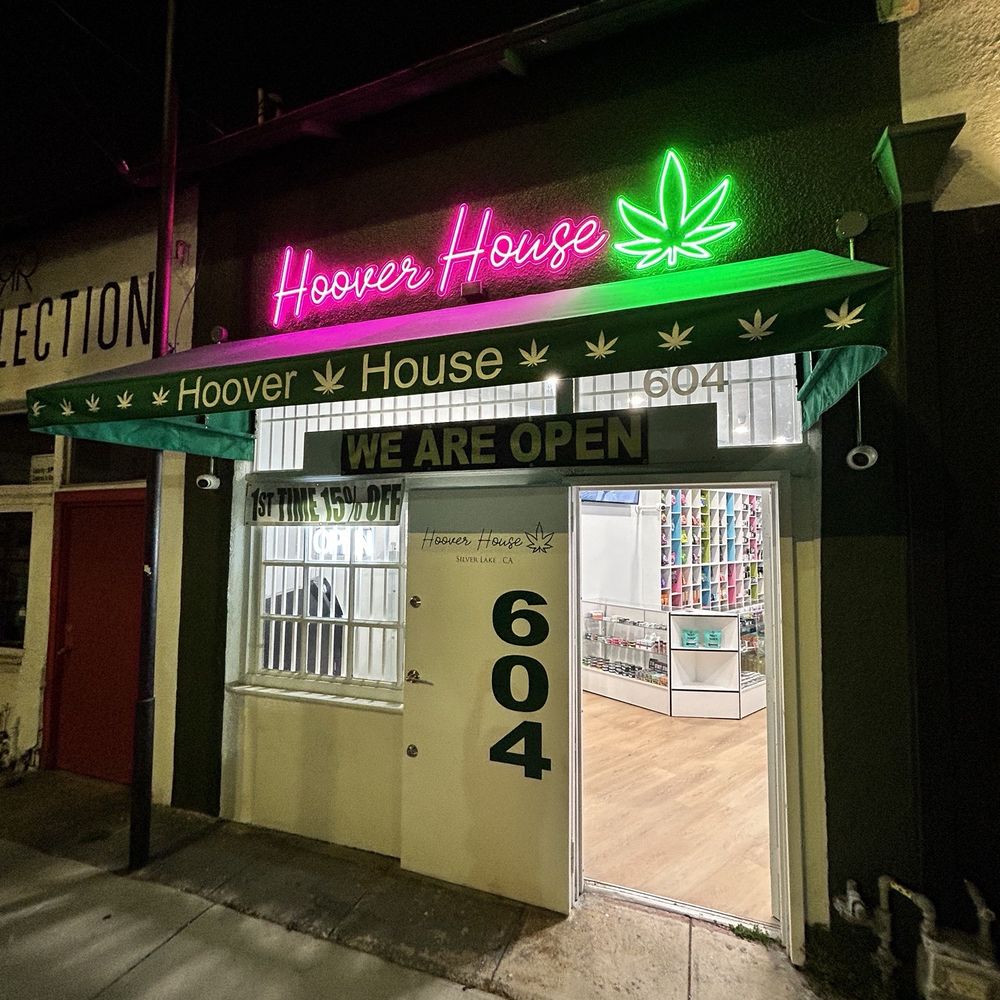
With eligible parcels identified, look at who already serves the customers around them, licensed or not. Modern MBA reports that, as of 2025, Los Angeles had almost ten times as many unlicensed storefronts (known locally as "trap shops") as licensed dispensaries, selling at least 35% below legal shelf prices because they collect no tax. A licensed store can't avoid those taxes, so the price gap you're up against is mostly a tax gap.
Count three layers within your trade area, the zone most of your customers will come from:
- licensed storefronts, which the state and city publish
- licensed delivery services, which reach your customers without a storefront. Check which are still active, since two thirds of California's delivery services closed between 2020 and 2025
- unlicensed shops, which you'll only find by driving the area, reading local news and checking enforcement reports
A trade area with five licensed stores and no visible illicit activity can be a better bet than one with a single licensed store and a dozen trap shops, because the absence of trap shops suggests customers there already pay legal prices. Where unlicensed shops clearly outnumber licensed ones, don't plan to match them on price: your taxes make that impossible. Instead, assume some customers will keep buying from them, and check whether your plan still works if, say, a quarter of your expected sales never show up. If it doesn't, drop the area.
Step 4: Size your trade area by drive time, not radius

Once you have a shortlist of legal parcels, the question becomes who can reach each one. Dispensary visits are usually planned car trips rather than impulse stops, so the right way to draw your catchment area (another name for your trade area) is by drive time: the area someone can reach within 10 or 15 minutes by car, rather than a simple circle on a map.
Local bans stretch trade areas. If surrounding cities prohibit storefronts, their residents drive to the nearest legal store, well past the usual 10-minute line. That's why Mecca's owner chose Bell Gardens for her next opening. The neighboring cities ban cannabis retail, Mecca would be one of the first legal dispensaries there, and few others are yet able to serve that demand.
For each parcel, work out how many adults live within a 10- and 15-minute drive, how many of them live in cities that ban retail, and how many live closer to an existing legal store than to yours. Say 200,000 adults live within 15 minutes of a parcel. If 80,000 of them live closer to a rival store, you can realistically win about 120,000. And if 60,000 of those live in cities that ban retail, you're their closest legal option. If this is your second store, also measure how much of the new trade area overlaps your first one, since every customer in the overlap is one you already have.
This is where Gini by MyTraffic fits. It draws drive-time trade areas around each parcel, maps the licensed competitors inside them and shows the vehicle traffic passing each site, anywhere in the 50 states. That lets you lay the parcels that clear your buffer map side by side and compare them on the same terms.
Then check when that traffic actually passes. Drive by on a weekday at 7pm and on a Saturday afternoon, not just during the morning commute, because a corridor that empties after 6pm won't suit a store that relies on after-work trips.
Step 5: Model your taxes, including 280E
The federal government sorts controlled drugs into five "schedules." Schedule I, the strictest, is for drugs it considers to have no accepted medical use, and that's where cannabis has sat for decades. Section 280E of the US tax code stops any business selling Schedule I or II drugs from deducting ordinary business expenses such as rent, wages and marketing. You can still deduct what you paid for the product, so a dispensary pays federal income tax on gross profit (sales minus product costs) rather than on actual profit.
Here's what that does to an example store paying the 21% federal corporate tax rate, before state taxes. It sells $3 million a year, buys product for $1.5 million and spends $1.2 million on rent, staff and everything else, leaving $300,000 of profit before tax. A normal retailer would owe $63,000. Under 280E, the store owes 21% of the $1.5 million gross profit, which is $315,000, so it ends the year $15,000 down despite trading profitably.
Recreational-use cannabis stays in Schedule I and fully under 280E. A DEA hearing on rescheduling the rest of the market ended in July 2026 and, as of late September 2026, its recommended decision was still pending. If you hold both a medical and an adult-use license, you'll have to split shared costs like rent between the two, and as of October 2026 the Treasury hadn't said how. Model your P&L under 280E as the base case and treat broader rescheduling as a bonus.
State and local taxes stack on top. California charges an excise tax, a state tax on cannabis sales on top of regular sales tax, on gross retail sales. After a brief rise to 19% in mid-2025, a state law (Assembly Bill 564) brought it back to 15% from October 1, 2025 until June 30, 2028, according to DCR's tax page. Add sales tax and, in the City of Los Angeles, the city's 10% cannabis business tax, and the Modern MBA case calculates that the layers add up to roughly 35% on the shelf price. Because the excise tax is charged before discounts or returns, many California dispensaries run a final-sale policy, since a refund would cost them the product and the tax already paid on it.
Step 6: Plan your funding and cash handling from day one
Getting in takes capital. IndicaOnline's dispensary cost guide puts the total at $150,000 to $2 million depending on state and model, with $350,000 to $750,000 of build-out for a 3,500-square-foot store. In California, annual license renewal fees run from $2,500 to $96,000 depending on revenue, so your fixed costs rise as your sales do.
Raising that money is harder than for other retail. Adult-use cannabis remains federally illegal, and the 2026 move of medical cannabis to Schedule III hasn't on its own opened bank accounts. Most national banks still won't serve dispensaries, card networks don't process cannabis sales and the Small Business Administration doesn't lend to the sector, so plan to fund the store without a bank loan.
Step 7: Choose an operating model you can defend
The product on your shelves will mostly be the product on everyone else's, and the three Los Angeles operators in the Modern MBA case each found a different answer to that.
Mecca integrated vertically, meaning it controls the supply chain from growing to the shelf. Its owner also runs a cultivator, a manufacturer and a distributor, and inspects shipments every week. She only puts the Mecca brand on flower that meets her standard. That lets her undercut the big names on her own label by about a fifth and still run the store at a 25% operating margin. The model needs growing know-how and capital most first-time operators don't have.
ERBA runs on consignment: brands keep ownership of their product until it sells, and some rent shelf space directly. ERBA carries no inventory risk across 1,200 products and doesn't have to predict which strain sells next. The trade-off is a 12% margin and a model that only works once the store draws enough traffic for brands to want the shelf, which brings you back to Steps 2 to 4.
HERB, a delivery-only service, skips the storefront and brings in about $3 million a year at a 5% margin. Startup costs are lower, but most storefronts also deliver, so a delivery-only service competes with every store in range and has no physical presence to set it apart.
What to check before you sign anything
Before you sign a lease or file an application, you should be able to answer yes to each of these:
- Does your state allow the license you want, and does the target city allow storefront retail, with an application window open?
- Does the parcel clear every state and local buffer, measured in a straight line on the regulator's latest data?
- Will the landlord accept a cannabis tenant?
- Have you counted the licensed stores, delivery services and unlicensed shops in the trade area?
- Does the drive-time trade area, including residents of neighboring cities that ban retail, support your sales target?
- Does the P&L still work under 280E and every layer of state and local tax?
- Do you have funding for licensing, build-out and rent while you wait for approval, without relying on a bank loan?
- Do you have a bank or credit union lined up, and a plan for handling cash?
- Do you know the margin your operating model will give you, and does it cover your costs?
- Is there a quality-control process for every supplier?
Start with the buffer map, since it decides which properties are worth a visit, then compare the parcels that survive it side by side.
TL;DR
Product and price no longer separate dispensaries, so the checks you run before opening (a license path, a parcel that clears every buffer zone, a trade area the illicit market hasn't taken, and a profit and loss that survives the 280E tax rule) decide whether a store makes money.