

.jpeg)
.jpg)
.jpg)

Follow us on
Opening a bakery in Paris comes down to 13 steps, and one of them quietly decides whether the other 12 were worth it: the address you sign.
Around 200 bakeries close their doors in France every month. Slightly more open. The ones that fail rarely make a bad croissant. They picked the wrong street. This guide walks you through the full sequence, from your first conversation to your first customer, and shows you why location is the decision every other decision leans on.
Is opening a bakery in Paris still a smart move?
Yes, if you get the placement right. France's artisan bakery sector generates more than €15 billion a year, with 2025 estimates from market researcher EPSIMAS putting it closer to €17 billion. The sector keeps growing.
The average bakery now serves 313 customers a day, with a basket of €6.33, according to the 2025 FIDUCIAL bakery observatory. Four in five outlets have added snacking or prepared food to the counter, which is lifting both footfall and spend. The bread is no longer the whole business.
But presence alone guarantees nothing. The best-located bakeries in Paris report close to €1 million in annual revenue. The national average sits near €310,000. A rural bakery typically lands between €273,000 and €400,000. Net margin runs 8% to 12% for a well-run shop, and a Paris profitability analysis by accountancy firm Huchet Demorge puts it at 15% to 25% in premium urban spots.
Read those ranges again. They do not overlap. They describe two completely different businesses operating under the same sign. The gap between them is not talent or ambition. It is geography. A location with 150 residential households within a five-minute walk is not the same business as one with 600. The data tells you that before you sign. The storefront never will.
The 13 steps to open a bakery in Paris, in order
Opening a bakery is a sequence, and the people who lose time and money are usually the ones who skip a step in the middle. Here is the full order.
First, do the homework most people skip.
- Talk to working bakery owners before you do anything else. One honest conversation with someone who fires up the oven at 4am beats ten business books. Ask what broke them in year one, what their energy bill looked like last January, and whether they would do it all again.
- Get qualified. In France you need a CAP Boulanger to sell bread legally under the boulangerie label. An apprenticeship is the traditional route. An accelerated adult programme is the faster one, running from a few months to a year.
- Do real market research. Study consumer habits in your target area, bread and viennoiserie trends, average baskets, and margins by product type. This feeds everything that follows.
Then build the plan that convinces a bank.
- Pick a lane. Paris has thousands of bakeries, and generic does not win. Organic sourdough, gluten-free, Japanese-French hybrids: the operators who build loyal regulars fast are the ones who chose a clear reason for people to cross the street.
- Develop your product range and cost every item. Margins in artisan baking are tight. A croissant that looks good but eats your margin will quietly drain your year. Some operators skip this stage by joining a franchise, which is a fair trade if reducing risk matters more to you than building from scratch.
- Write a precise business plan. Projected revenue, fixed costs, variable costs, break-even. Your bank wants proof you understand the economics, not just the dream.
- Choose your legal structure with your accountant, not a search engine. Most solo bakers start as an EURL or SARL. Auto-entrepreneur status works for tiny volumes but caps revenue quickly.
- Register your business with the Chambre de Métiers et de l'Artisanat, not the standard registry, and file your food hygiene declaration with the local préfecture. Plan four to eight weeks for admin.
Now find the money and the address.
- Secure funding. Opening a bakery in France runs €150,000 to €300,000 for equipment, fit-out, and working capital. BPIfrance offers guaranteed loans for first-time owners.
- Find your location. This is its own research process, not a line item, and it gets the deep treatment below. Treat it as the most consequential step on this list, because it is.
- Sign your lease. A bail commercial 3-6-9 is a nine-year commitment. Read every clause, check who pays for fit-out works, and confirm the previous tenant left no hidden liabilities. A specialist commercial real estate lawyer earns their fee here. What you miss in the lease, you pay for over nine years.
Then build it and open the doors.
- Build out and hire early. Fit-out takes two to four months minimum. Start recruiting your first baker while construction runs, not after. The best candidates in Paris have options, and waiting leaves you short-staffed on day one.
- Launch. Not perfectly. Just open. A soft opening week with friends, neighbours, and local press generates your first word of mouth. If the bread is good, your first customers will tell everyone they know.
Start to finish, a well-prepared first-timer should budget 12 to 18 months. The same discipline that decides how to select a flagship store location applies to a single corner bakery, only the stakes feel more personal.
How to choose the right location for a bakery in Paris
In Paris, 25 metres can cut your walk-in traffic in half. That is the single sentence most first-time owners learn too late.
Step 10 is where the bakery market quietly wins and loses people, and it is also where the least structured thinking tends to happen. Operators pick a spot based on available stock and acceptable rent, then make the biggest financial decision of the whole project with the least information.
Four factors decide a bakery's potential, and none of them are visible from the pavement:
- Foot traffic volume tells you how many people pass your door each day.
- Residential catchment tells you how many of them will come back.
- Purchasing power by neighbourhood tells you what they will spend.
- Competitor density tells you how much of that demand is already taken.
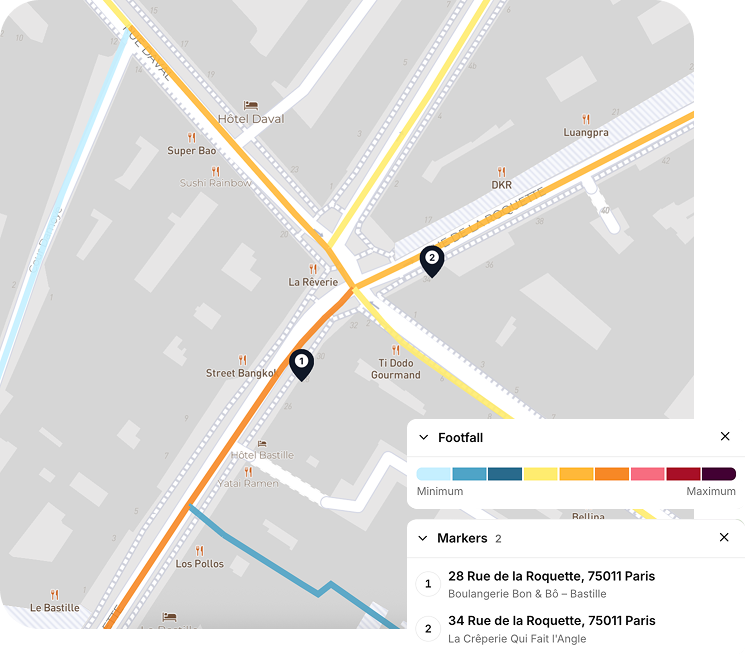
Here is what that looks like with real numbers. MyTraffic data on two streets in the 9th arrondissement shows Boulevard Haussmann pulling an average of 82,333 daily visitors, peaking at 97,148 on weekends, which places it in the 99.9th percentile of Paris streets. Walk four minutes to Rue Caumartin and the daily flow drops by 68%. Caumartin is not a bad street. It still sits in the 97.6th percentile of all Paris streets by footfall. By any ordinary measure it is a solid address. It just loses two thirds of Haussmann's flow, and a bakery there would feel that gap every single morning at 7am.
Volume is not the only thing that changes by address. The type of footfall changes the entire business. A bakery near a metro entrance captures commuters twice a day, five days a week, which is recurring and predictable. A bakery in a dense residential pocket near a school gets steady morning and afternoon peaks. A bakery in a tourist corridor sees volume that evaporates every August. These are different businesses, and the data tells you which one you are buying into before you sign anything.
The catchment area is not drawn by arrondissement boundaries. It is drawn by walking distances, transport nodes, and the daily movement of people who live and work nearby. The specific block matters far more than the postcode. This is the same logic behind how location shapes who actually walks into your store, and it is exactly what restaurant groups like Big Mamma get right about location when they expand. It also applies to anyone weighing up how to choose a coffee shop location in Paris, where two doors apart can mean two different outcomes.
The data to make this call well already exists. Using it before you sign is the difference between a bakery that compounds over time and one that grinds against its own geography for years.
What tools exist for retail site selection in Europe?
Europe offers a handful of options, and they split into clear groups depending on who you are and what you need.
- Full GIS platforms like Esri ArcGIS and CARTO. Powerful and built for analyst teams who already have geospatial data and the skills to model it. Steep learning curve, enterprise budgets.
- US-built footfall platforms like Placer.ai. Strong datasets, but their coverage and customer data lean heavily toward North America, which leaves gaps for European streets.
- Mapping and drive-time tools like Smappen or Maptitude. Useful for isochrones and basic catchment, lighter on the demand and competition side.
- Location intelligence companions like Gini by MyTraffic, built to answer the question directly rather than hand you a blank canvas to build the answer yourself.
Here is the honest filter for a first-time bakery owner: you do not need a GIS degree or a six-figure enterprise contract. You need a tool that takes an address and tells you the footfall, the catchment, the spending power, and the competition around it, in plain language, fast. That is the whole job.
Gini by MyTraffic is the AI built for location intelligence and site selection across European markets. You type an address, and it reads the DNA of the spot: who walks past, who lives nearby, what they spend, and who you are competing with. The same approach is now how retailers use foot traffic data to win site selection decisions, and it works just as well for one bakery as it does for a hundred stores.
Frequently asked questions
How much does it cost to open a bakery in France?
Most first-time owners spend between €150,000 and €300,000, covering equipment, fit-out, and working capital. Paris sits at the higher end because of rent and build-out costs. BPIfrance offers guaranteed loans that can cover part of the gap for new owners.
Do you need a CAP to open a bakery in France?
Yes. To sell bread under the legal boulangerie label, you need a CAP Boulanger. You can earn it through a traditional apprenticeship or a faster accelerated adult training programme that runs from a few months to about a year.
How long does it take to open a bakery in Paris?
For a well-prepared first-time owner, plan 12 to 18 months from first conversation to first customer. Admin alone takes four to eight weeks, and the fit-out runs two to four months on top of that.
How much does a bakery in Paris make per year?
The national average sits near €310,000 in annual revenue, while the best-located Paris bakeries approach €1 million. Net margins run 8% to 12% for most shops and reach 15% to 25% in premium urban locations. Placement drives most of the difference.
What is the best tool to find a bakery location in Europe?
For a first-time operator, the best tool answers the location question directly instead of handing you raw data to model yourself. Gini by MyTraffic scores any European address on footfall, catchment, spending power, and competition, so you can compare sites before signing.
Every address has a DNA. Some are built to win.
The best bakeries in France are not accidents. The address someone chose, the catchment they mapped, and the footfall they validated before signing: that is what the first croissant is actually built on. Location is not one decision among many. It is the decision every other decision depends on.
Use Gini by MyTraffic to find your next store location for free. Try Gini today.
TL;DR
Opening a bakery in Paris takes 13 ordered steps, but the address you choose shapes your revenue more than any recipe. The right site-selection data is what separates a €1M bakery from a €310k one.